
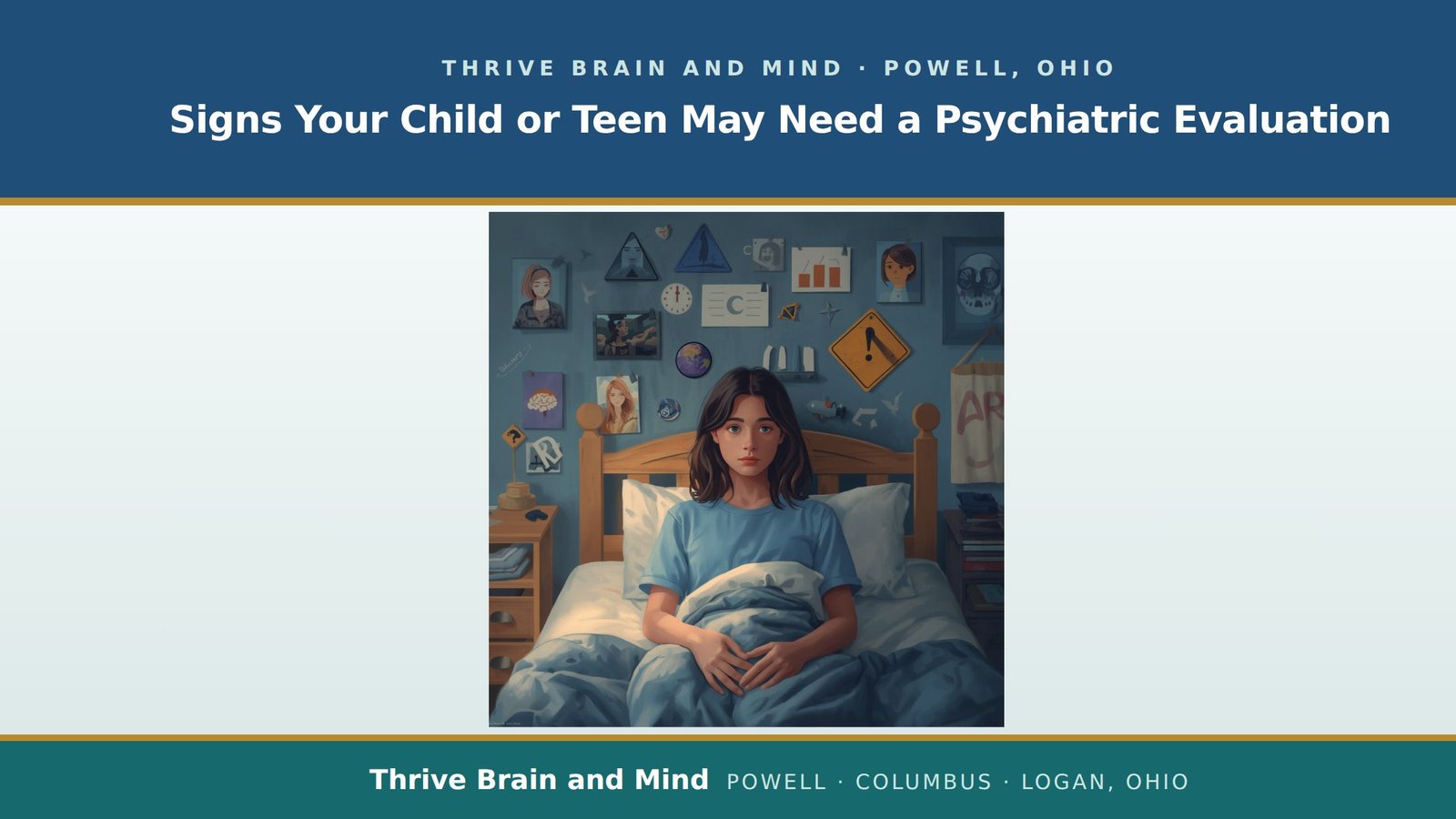
The bedroom door is closed again. Your daughter used to fill the kitchen with stories after school. Now she goes straight upstairs. Grades that were solid are sliding. She quit the team she loved. Dinner is one-word answers: “Fine.” “Nothing.” “Whatever.” And at 11 p.m., you’re lying awake asking the question every parent of a teenager eventually asks: is this just being fifteen — or is something wrong?
Or maybe your child is younger. Every school morning brings a stomachache. The pediatrician finds nothing. There are meltdowns over small changes, tears at drop-off, a child who suddenly won’t sleep alone at eight years old. People keep telling you “they’ll grow out of it.” But your gut says something different.
I’ve practiced psychiatry for more than 30 years, and at Thrive Brain and Mind we care for children, adolescents, and adults. Here’s what I want every parent reading this to know: your gut is data. Parents are almost always the first to sense that something has shifted — before a teacher, before the pediatrician, sometimes before the child can name it themselves. This post will help you tell a phase from a pattern, show you exactly what to do next, and tell you when not to wait.
“No parent wants to overreact. But in 30 years, I have almost never met a parent who regretted getting their child evaluated. I have met many who regretted waiting.”
How Common Is This? More Common Than You Think
Let’s start with the numbers, because they surprise most parents. About one in six U.S. children ages six to 17 has a treatable mental health disorder. That’s 7.7 million kids. And about half of them never get treatment. [1]
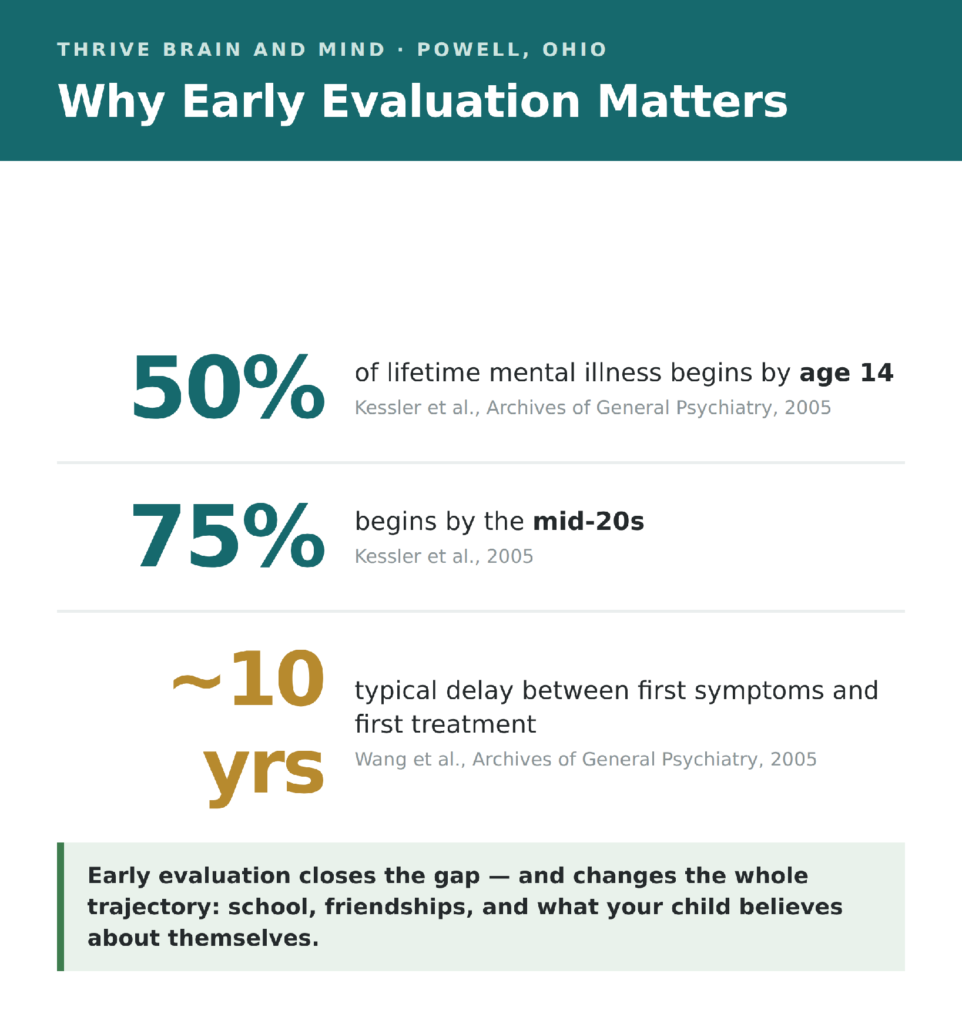
Timing matters more than most people realize. Half of all lifetime mental illness begins by age 14. Three-quarters begins by the mid-20s. [2] Yet the typical delay between first symptoms and first treatment is close to a decade. [3] That gap — the years between “something’s off” and “someone’s helping” — is where kids lose ground at school, with friends, and at home. Closing that gap is the whole point of an evaluation.
And today’s teens are carrying more than most of us did at their age. In the most recent national youth survey from the Centers for Disease Control and Prevention (CDC), about four in ten high school students reported feeling persistently sad or hopeless. One in five had seriously considered suicide. [4] If your child is struggling, they are not an outlier — and neither are you.
A Phase or a Pattern? The Three Questions I Ask
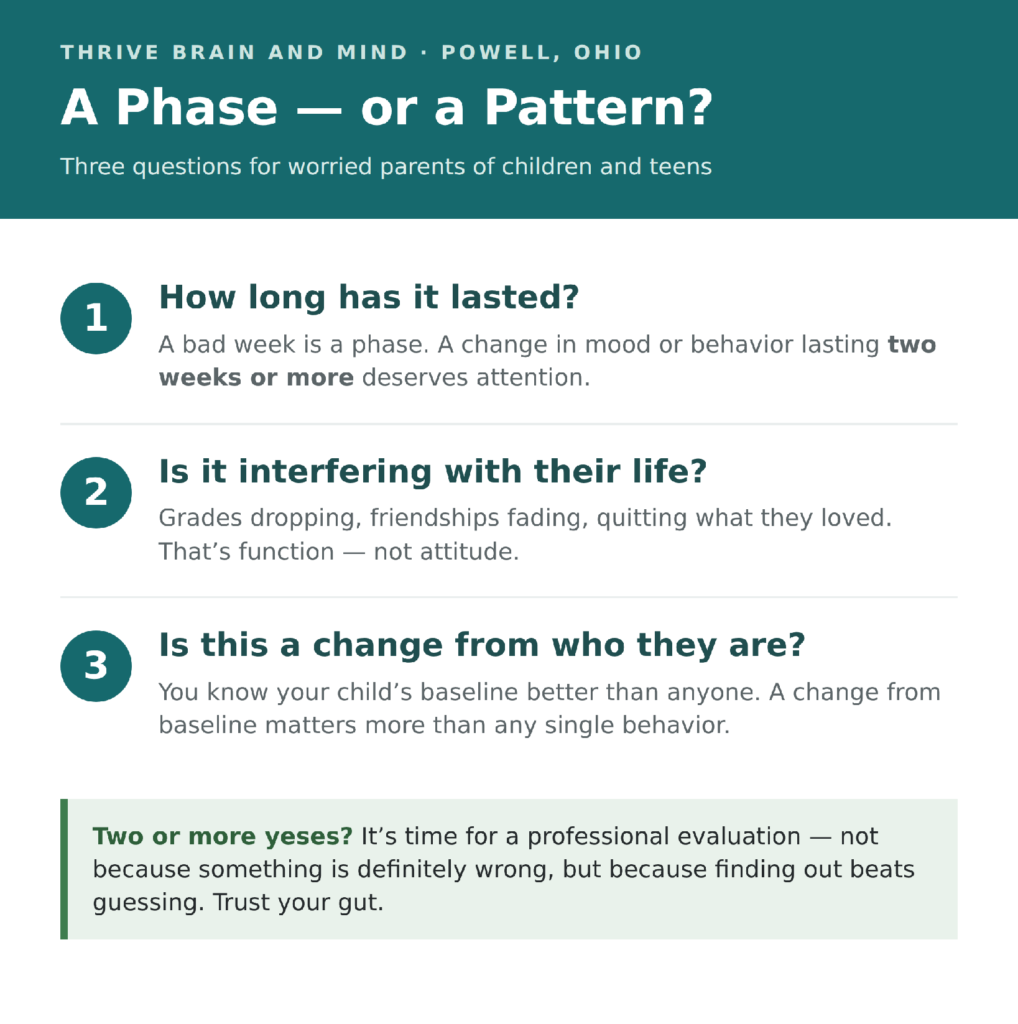
Moodiness, testing limits, wanting privacy — that’s adolescence doing its job. So how do you tell typical development from a warning sign? When parents call our office unsure, I walk them through three questions.
- How long has it lasted? A bad week is a phase. Most phases pass in days. When a change in mood or behavior persists for two weeks or more, take it seriously.
- Is it interfering with their life? Grades dropping. Friendships fading. Quitting activities they loved. Battles at home every night. When symptoms start costing your child things they care about, that’s function — not attitude.
- Is this a change from who they are? You know your child’s baseline better than anyone on earth. A social kid who withdraws. An easygoing kid who’s suddenly explosive. A change from baseline matters more than any single behavior.
Two or more yeses? It’s time for a professional look. Not because something is definitely wrong — but because finding out beats guessing. Every time.
| Typical development | Time for an evaluation | |
|---|---|---|
| Privacy | Wants more privacy, still connects at meals or in the car | Withdraws from everyone — including friends |
| Mood | Moody after a bad day, bounces back | Sad, empty, or irritable most days for two weeks or more |
| School | An off quarter, a slipped grade | A sustained drop, missing assignments everywhere, refusing to go |
| Sleep | Night-owl tendencies on weekends | Up most of the night, or can’t get out of bed at all |
| Anger | Eye-rolls, door slams, arguments that blow over | Rages out of proportion to the trigger, holes in walls, fear at home |
The Signs: What to Watch For
Here are the signs that most often mean a child or teen should be evaluated. No single item on this list makes a diagnosis. But each one, if it persists, deserves attention — not a wait-and-see.
Mood and behavior
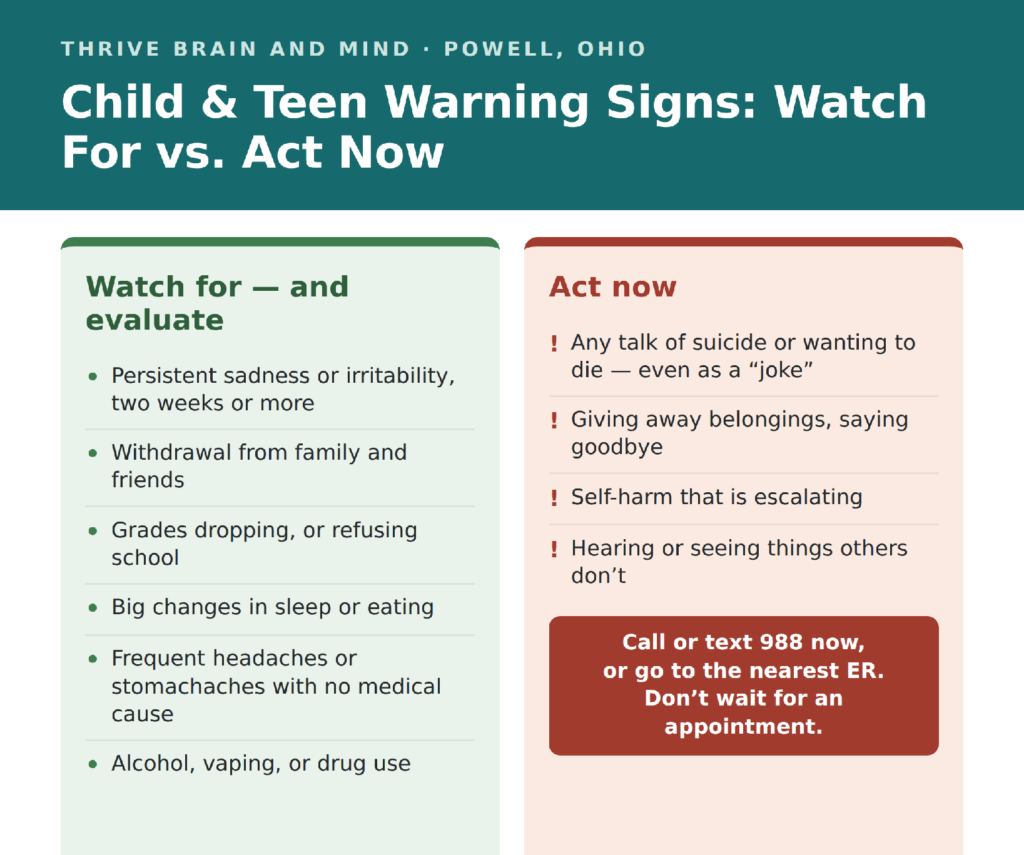
- Persistent sadness, tearfulness, or irritability lasting two weeks or more — in teens, depression often looks like anger, not sadness
- Loss of interest in things they used to love
- Withdrawal from family and friends
- Constant worry, fears that won’t respond to reassurance, or panic attacks
Body and daily life
- Frequent headaches or stomachaches with no medical cause — anxiety in children often shows up in the body first
- Big changes in sleep — can’t fall asleep, up all night, or sleeping constantly
- Changes in eating: sudden weight loss or gain, skipped meals, secretive eating, or obsession with body image
- A real drop in grades, or refusing to go to school
- In younger children: regression — new clinginess, bedwetting, baby talk, or separation panic that had previously resolved
Higher-risk signs in teens
- Alcohol, vaping, or drug use — especially using alone or to “feel normal”
- New risky or impulsive behavior — sneaking out, reckless driving, unsafe online activity
- Cutting or other self-harm, often hidden under long sleeves
- Hearing or seeing things others don’t, or beliefs that have broken from reality
Get help immediately
Any talk of suicide or wanting to die — even framed as a joke. Giving away belongings. Saying goodbye. Self-harm that is escalating. For any of these: call or text 988, the Suicide & Crisis Lifeline, right now, or go to the nearest emergency room. Do not wait for an appointment. Take every mention of suicide seriously. It is among the leading causes of death for young people ages 10 to 24. [5]
What to Do Tonight (and What Not to Do)
- Do open the door gently. Not an interrogation — an observation. “I’ve noticed you seem down lately. I’m not mad. I’m on your team.” Then listen more than you talk. You may get “I’m fine.” That’s okay. You’ve told them the door is open.
- Don’t dismiss it or wait for it to fix itself. “Toughen up” and “it’s just a phase” teach kids to hide symptoms — not solve them. Waiting is exactly how that decade-long treatment gap happens. [3]
- Don’t blame yourself — or your child. Mental health conditions are medical conditions. They are nobody’s fault. Kids don’t choose depression any more than they choose asthma.
- Do write down what you’re seeing. Two weeks of quick notes — sleep, mood, school, appetite, screens — is enormously useful at an evaluation. It turns “I’m worried” into a picture a psychiatrist can work with.
- Do make the call. You do not need a referral to be seen at Thrive Brain and Mind. If your gut says something is wrong, that is reason enough.
What Actually Happens at a Child Psychiatric Evaluation
For most parents, the scariest part is the unknown. So let me take the mystery out of it. At Thrive Brain and Mind, an evaluation for a child or teen is a conversation — not a lab test, not a verdict.
- We talk with you and your child — together and separately. Teens often share more one-on-one. Parents provide the history and the baseline. Both matter, and both shape the plan.
- We look at the whole picture. Sleep, school, friendships, family changes, medical history, screens, substances. Symptoms in kids rarely come from just one place.
- We screen for look-alikes. Attention-deficit/hyperactivity disorder (ADHD) can look like laziness. Anxiety can look like defiance. Depression can look like a bad attitude. Getting the diagnosis right is everything — it’s the difference between years of “try harder” and a plan that works.
- You leave with a plan. A clear explanation of what we found, in plain language, and a personalized path forward. We walk you through every option — and every choice stays with you.
Now, the fear I hear most from parents: “I don’t want my child medicated for being a kid.” Good. Neither do I. An evaluation is not a prescription. Therapy is often the first-line treatment for children and teens, and when medication is appropriate, it’s a careful, closely monitored decision we make together — and when it isn’t appropriate, I’ll tell you that plainly. For older teens with depression that hasn’t responded to standard treatment, there are also options that didn’t exist a few years ago. In 2024, the U.S. Food and Drug Administration (FDA) cleared Transcranial Magnetic Stimulation (TMS) — a non-medication treatment that uses magnetic pulses to stimulate the brain’s mood circuits — as an add-on treatment for adolescents 15 and older. [6] Very few practices in central Ohio offer it. We do.
“An evaluation is not a label, and it is not a prescription. It is information — and information is what turns a worried parent back into a confident one.”
The Results: What Early Help Changes
A family I’ll call the Andersons (details changed to protect privacy) brought me their 15-year-old son last fall. Grades down, door closed, one-word answers — his mom had been up at midnight reading an article a lot like this one. The evaluation found depression hiding behind irritability, plus ADHD that had quietly chipped away at his confidence for years. We started therapy, treated the ADHD, and added a carefully chosen antidepressant with his parents involved at every step. By spring, his mom told me the sound she’d missed most was back in the house: laughing behind that same bedroom door — this time with friends on the other end of it.
That’s what the research shows at scale, too. Mental health conditions in young people are highly treatable — and the earlier the help, the better the trajectory. Because half of lifetime mental illness starts by age 14, [2] treating it at 14 instead of 24 changes the entire arc: school, friendships, self-image, and what your child believes about themselves for the rest of their life.
And sometimes the result of an evaluation is reassurance: this is within normal development, here’s what to watch for, come back if it changes. That answer is worth every bit as much. Either way, you stop guessing — and your child learns that in your family, asking for help is normal.
One Practice for the Whole Family — in Powell and Columbus, Ohio
Here’s something most parents don’t discover until they start calling around: the majority of psychiatry practices in central Ohio see adults only. Thrive Brain and Mind provides psychiatric care for children, adolescents, and adults of all ages. Your teen, you, even a grandparent — one practice, one team, one picture of the whole family. That matters more than it sounds, because depression and anxiety run in families, and a parent getting help is one of the most powerful examples a struggling kid can see.
- Evaluation-first, always. A thorough evaluation and an honest conversation — never a rushed visit that ends in a prescription by default.
- Credentials for the hard cases. I’m Dr. John J. Aziz, a quadruple board-certified psychiatrist with more than 30 years of experience — including board certification in addiction medicine, which matters when a teen’s struggles involve vaping, alcohol, or drugs.
- The full toolbox. Therapy, careful medication management, and advanced options like TMS for adolescents 15 and older when standard treatment hasn’t worked.
- No referral needed. Call us directly. Our team verifies your insurance before the first visit, and telehealth is available for select evaluations.
We serve families across the greater Columbus area — Dublin, Westerville, Lewis Center, Delaware, and Upper Arlington — from our clinic at 3785 Attucks Drive in Powell, Ohio, with a second office in Logan for southeastern Ohio. If tonight was the night your gut finally said “make the call” — make it.
→ Schedule a child or teen evaluation at Thrive Brain and Mind — call 614-588-8177. No referral needed.
Frequently Asked Questions
At what age can a child see a psychiatrist?
There is no age that’s “too young” to ask the question. Thrive Brain and Mind provides psychiatric care for children, adolescents, and adults. If you’re seeing persistent changes in a child of any age, call us — and if a different type of care would fit your child better, we’ll point you in the right direction.
How do I know if my teen’s behavior is normal or a mental health problem?
Ask three questions. Has the change lasted two weeks or more? Is it interfering with school, friendships, or family life? Is it a clear change from who your child usually is? Two or more yeses means it’s worth a professional evaluation. Trust your gut — parents are usually the first to notice.
What happens during a psychiatric evaluation for a child or teen?
It’s a structured conversation, not a lab test. The psychiatrist talks with the parent and child — together and separately — about mood, sleep, school, friendships, medical history, and family history, and screens for conditions like anxiety, depression, and attention-deficit/hyperactivity disorder (ADHD). You leave with a clear explanation and a personalized plan. At Thrive Brain and Mind, no referral is needed.
Will my child automatically be put on medication?
No. An evaluation is not a prescription. Therapy is often the first-line treatment for children and teens. If medication is recommended, it’s a careful decision made with parents, started conservatively, and monitored closely — and if it isn’t needed, we’ll say so plainly.
What are the emergency warning signs in a child or teen?
Any talk of suicide or wanting to die (even as a “joke”), giving away belongings, saying goodbye, escalating self-harm, or hearing and seeing things that aren’t there. For any of these, call or text 988 — the Suicide & Crisis Lifeline — right away, or go to the nearest emergency room. Don’t wait for an appointment.
Where can I find a child and adolescent psychiatrist near Columbus, Ohio?
Thrive Brain and Mind in Powell, Ohio provides psychiatric care for children, adolescents, and adults across the greater Columbus area. Evaluations, therapy, medication management, and TMS for adolescents 15 and older are available, with no referral needed. Call 614-588-8177 to schedule an evaluation with Dr. John J. Aziz.
This article is for education and is not a substitute for personalized medical advice, diagnosis, or treatment. If your child may be in crisis, call or text 988 — the Suicide & Crisis Lifeline — or go to the nearest emergency room. Available 24/7.
RESOURCES & STUDIES CITED
1. Whitney DG, Peterson MD. US national and state-level prevalence of mental health disorders and disparities of mental health care use in children. JAMA Pediatrics. 2019;173(4):389–391. https://pubmed.ncbi.nlm.nih.gov/30742204/
2. Kessler RC, et al. Lifetime prevalence and age-of-onset distributions of DSM-IV disorders in the National Comorbidity Survey Replication. Archives of General Psychiatry. 2005;62(6):593–602. https://pubmed.ncbi.nlm.nih.gov/15939837/
3. Wang PS, et al. Failure and delay in initial treatment contact after first onset of mental disorders in the National Comorbidity Survey Replication. Archives of General Psychiatry. 2005;62(6):603–613. https://pubmed.ncbi.nlm.nih.gov/15939838/
4. Centers for Disease Control and Prevention. Youth Risk Behavior Survey: 2023 results. https://www.cdc.gov/yrbs/results/2023-yrbs-results.html
5. Centers for Disease Control and Prevention. Suicide data and statistics. https://www.cdc.gov/suicide/facts/data.html
6. Neuronetics. NeuroStar Advanced Therapy receives FDA clearance as a first-line add-on treatment for adolescents (ages 15–21) with depression. March 2024. https://ir.neuronetics.com/news-releases/news-release-details/neurostarr-advanced-therapy-receives-fda-clearance-first-line
7. American Academy of Child & Adolescent Psychiatry. When to seek help for your child (Facts for Families) — additional parent resource, not cited in text. https://www.aacap.org/AACAP/Families_and_Youth/Facts_for_Families/FFF-Guide/When-To-Seek-Help-For-Your-Child-024.aspx