
You did the hard part. After years of medications that half-worked or didn’t work at all, you said yes to something different. The insurance approval came through. Your first Spravato session is on the calendar — or maybe it was last Tuesday. And now your brain is doing the thing every patient’s brain does: counting. Is it working yet? Should I feel something by now? How long does this take?
A patient I’ll call Rachel (details changed to protect privacy) — a 38-year-old nurse and mom of two — started Spravato at our Powell clinic after three antidepressants had failed her. At the end of week two, she sat across from me and asked the exact question that probably brought you to this page: “Doc, when do I get to feel it?”
It’s the right question, and it deserves a real answer — not “everyone’s different,” which is true but useless at 2 a.m. So here is the honest, week-by-week map I give my own patients: what typically happens, when it tends to happen, what can change the pace, and what we do if the numbers don’t move.
“The two biggest mistakes I see with Spravato are quitting at week two and coasting at week six. Both come from not knowing the timeline.”
First, a 60-Second Refresher: What Spravato Is
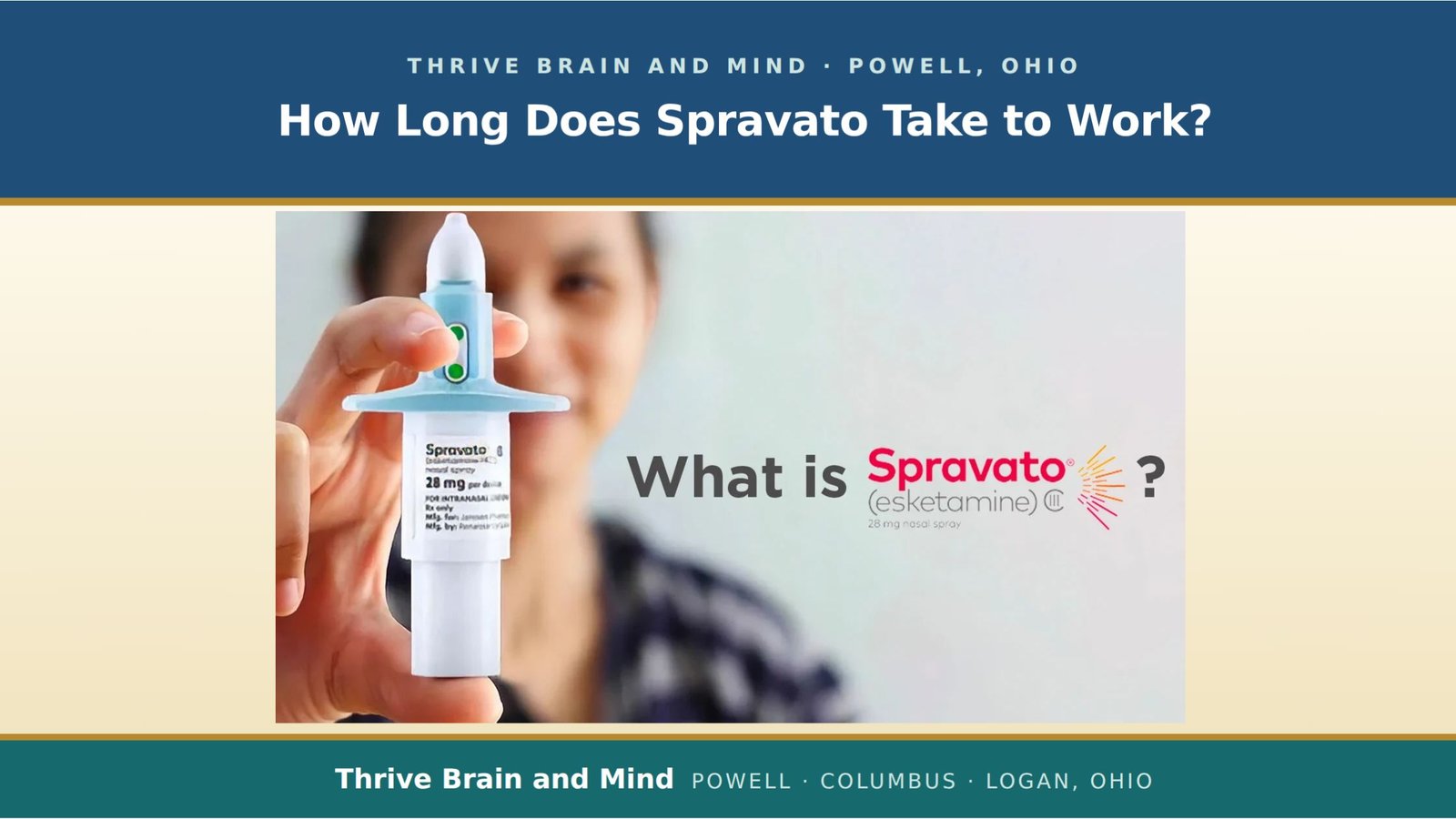
Spravato (esketamine) is a nasal spray approved by the U.S. Food and Drug Administration (FDA) for treatment-resistant depression (TRD) — depression that hasn’t responded to at least two antidepressants — and for major depressive disorder with acute suicidal thoughts or actions. It works on the brain’s glutamate system, a completely different pathway than the serotonin most antidepressants target. That different pathway is why it can work when other medications haven’t — and why it runs on a different clock. As of the FDA’s 2025 update, Spravato can be used for treatment-resistant depression on its own or alongside an oral antidepressant. [1]
You take it in our office, under supervision, with about two hours of monitoring after each dose — it is never a take-home medication. That structure is part of a federal safety program called a Risk Evaluation and Mitigation Strategy (REMS), and Thrive Brain and Mind is a REMS-certified treatment center. [2]
Read This First: Everyone’s Clock Runs a Little Differently
Before I give you the timeline, I owe you the disclaimer I give every patient in my office: this is a map of the typical journey — not a promise, and not a deadline. In the same week, I’ll see one patient who felt lighter the morning after session one, and another who felt nothing until session seven and went on to full remission. Both are normal. Neither predicted how well the treatment worked in the end.
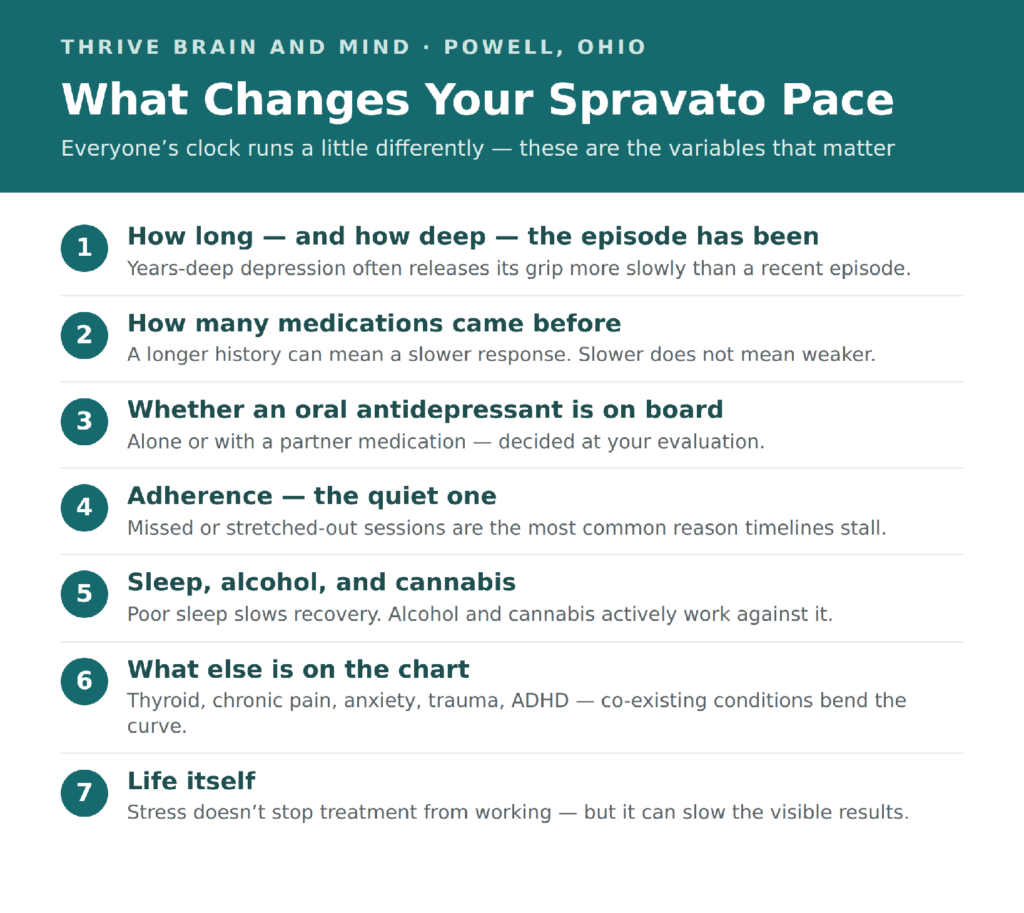
So what makes one person’s clock run faster or slower than another’s? These are the variables that matter most:
- How long — and how deep — this episode has been. Depression that has been dug in for years often takes longer to release its grip than a more recent episode.
- How many medications came before. A longer history of failed trials can mean a slower, more gradual response. Slower does not mean weaker — it does not lower your ceiling.
- Whether an oral antidepressant is on board. Some patients take Spravato on its own, others alongside a partner medication. The right combination — decided at your evaluation — can shape the pace.
- Adherence — the quiet one. Missed or stretched-out sessions are the most common reason timelines stall. The twice-a-week rhythm in the first month is doing real work.
- Sleep, alcohol, and cannabis. Poor sleep slows recovery. Alcohol and cannabis actively work against it.
- What else is on the chart. Thyroid problems, chronic pain, anxiety, trauma, attention-deficit/hyperactivity disorder (ADHD) — co-existing conditions bend the curve, which is why we treat the whole person, not the calendar.
- Life itself. A layoff, a divorce, a sick parent in the middle of treatment. Stress doesn’t stop Spravato from working, but it can slow the visible results.
Use the weeks below as guardrails for your expectations — not a countdown clock. The goal isn’t to be “on schedule.” The goal is a trend line that’s moving. And that is exactly what we measure.
Your Task: Judge the Timeline, Not the Moment
Here’s your job as a patient, in one sentence: give the treatment its full window, and measure instead of guessing. Depression lies. On a gray Tuesday it will whisper that nothing is working. That’s why we track your symptoms at every visit with a short standardized checklist — the Patient Health Questionnaire-9 (PHQ-9). Numbers don’t have gray Tuesdays.
- Don’t judge by day three. Some people feel a shift in the first 24 hours. Many don’t feel much until week two, three, or four. Both paths are normal, and neither predicts your final result.
- Don’t skip sessions to “see how it goes.” The induction schedule is where results are built. If you’re discouraged, bring the discouragement to your session — that’s data, and we want it.
- Do keep the week-4 review on the calendar. That’s our formal decision point: continue, adjust, or pivot. You will never be left drifting.
And one thing outranks the whole timeline: if you have thoughts of suicide while you wait for treatment to work, don’t wait it out alone. Call or text 988, the Suicide & Crisis Lifeline, right now, or go to the nearest emergency room.
The Week-by-Week Spravato Timeline
Before day one: clearance for takeoff
Once your evaluation confirms Spravato is a fit, our team verifies your insurance and handles the approval paperwork before you ever sit in the chair. You’ll get simple prep rules: no food for about two hours before your session, no liquids for about 30 minutes before, and a ride home arranged — no driving until the next day, after a restful night’s sleep. [2]
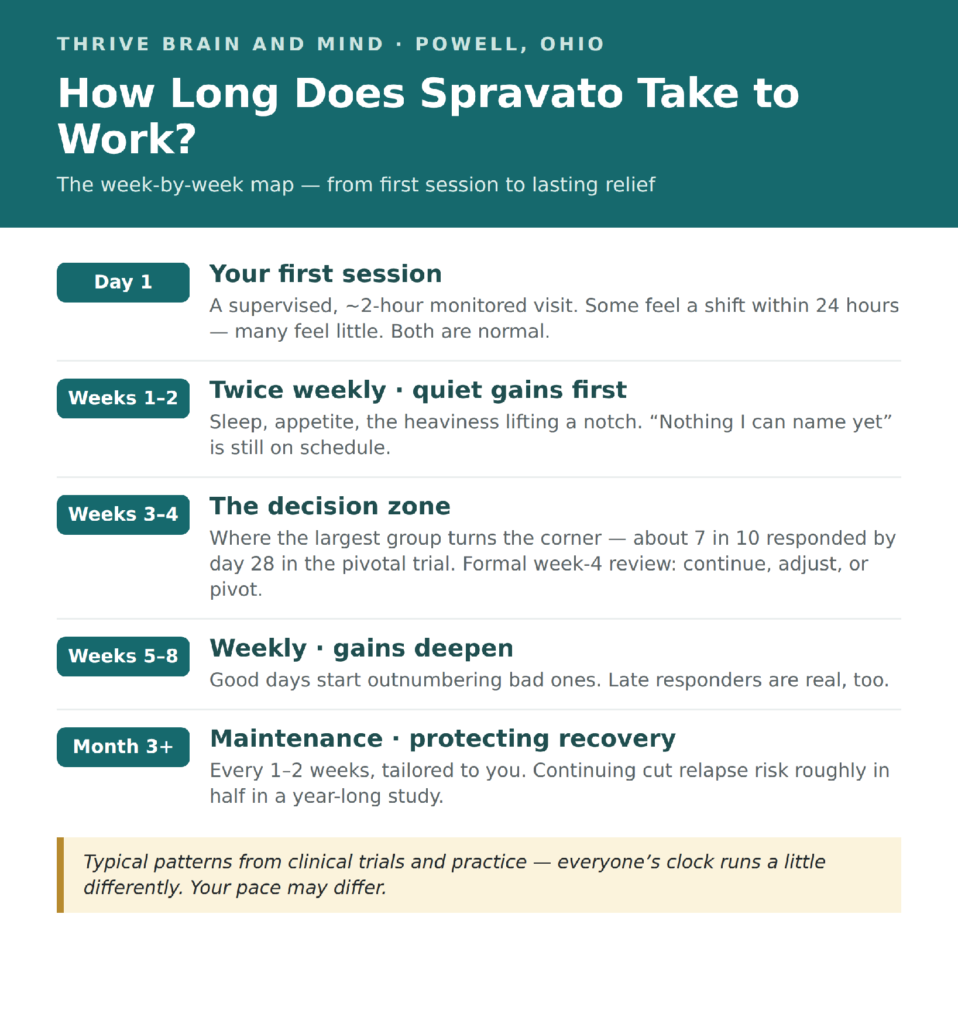
Day 1 — your first session
You’ll be in a private, comfortable room. You administer the nasal spray yourself, under our supervision, then recline while we monitor you for about two hours — including your blood pressure before and after. Most people feel something dreamlike or “floaty” for 40 minutes to an hour: dissociation, sometimes dizziness or nausea. It’s temporary, it’s expected, and it settles before you leave. Side effects are usually strongest on day one and shrink with each session as your brain adjusts.
Will you feel better that night? Maybe — in the trial behind the 2025 monotherapy approval, patients on Spravato showed measurable improvement about 24 hours after the first dose, on average. [3] But hear me clearly: most people do not feel a dramatic change after one session. That tells us nothing about whether it will work for you.
Weeks 1–2 — sessions one through four
Induction runs twice a week for the first month. [2] When early gains show up, they usually arrive quietly and physically first: sleeping through the night, a little more appetite, the heaviness lifting a notch, the anxious edge coming off. Rachel felt “nothing I could name” at week two — which, as I told her, is right on schedule for a large share of my patients.
Weeks 3–4 — sessions five through eight: the decision zone
This is where the largest group turns the corner. In the pivotal four-week trial, roughly seven in ten patients on Spravato plus an oral antidepressant responded by day 28, and about half reached remission — few or no remaining symptoms. [4] At the end of week four, we sit down with your PHQ-9 curve and decide together: clear response — continue and consolidate. Partial response — usually continue, because partial responses often deepen. No movement at all — an honest conversation about adjusting the plan or pivoting. You will not be strung along.
Weeks 5–8 — weekly sessions, deepening
If treatment continues, sessions taper to once a week. [2] For most responders, this is consolidation: the good days start outnumbering the bad ones, and the gains stop feeling fragile. Late responders are real, too — some patients who were “almost there” at week four cross into remission during this stretch.
Month 3 and beyond — maintenance
From week nine on, sessions move to every week or every two weeks, tailored to you. [2] Patients sometimes ask why they should keep coming once they feel like themselves. Because staying is what protects the recovery: in a year-long study, patients who continued esketamine after getting well cut their risk of relapse roughly in half compared with those who switched to placebo — and the protection was even larger for those who had responded without reaching full remission. [5] How long you stay on maintenance is individual, revisited regularly, and always your decision made with full information.
| Phase | Visit rhythm | What many patients notice | What we’re doing |
|---|---|---|---|
| Day 1 | First session | Dreamlike “floaty” hour; side effects strongest today, then shrink | Monitoring, comfort, baseline PHQ-9 |
| Weeks 1–2 | Twice weekly | Quiet, physical gains first: sleep, appetite, less heaviness — or nothing yet (also normal) | Tracking scores, tuning the plan |
| Weeks 3–4 | Twice weekly | The big turn for many: mood, interest, hope | Formal week-4 review: continue, adjust, or pivot |
| Weeks 5–8 | Weekly | Gains deepen and stabilize; late responders cross over | Confirming durability, planning maintenance |
| Month 3+ | Every 1–2 weeks | Feeling like yourself; protecting the recovery | Relapse prevention, spacing sessions to your life |
Ranges reflect typical patterns from clinical trials and practice — your pace may differ. See “Everyone’s Clock Runs a Little Differently” above.
The Results: What “Working” Actually Feels Like
Back to Rachel. Week two: nothing she could name. Week three, after session six: “It’s like someone turned the static down.” Week five: she was baking with her daughter again — her own early-warning system in reverse. Her PHQ-9 told the same story: 19 at day one, 11 at the week-4 review, 6 by week eight. She’s on maintenance every two weeks now, and at her last visit she used the word she’d been afraid to say out loud: herself.
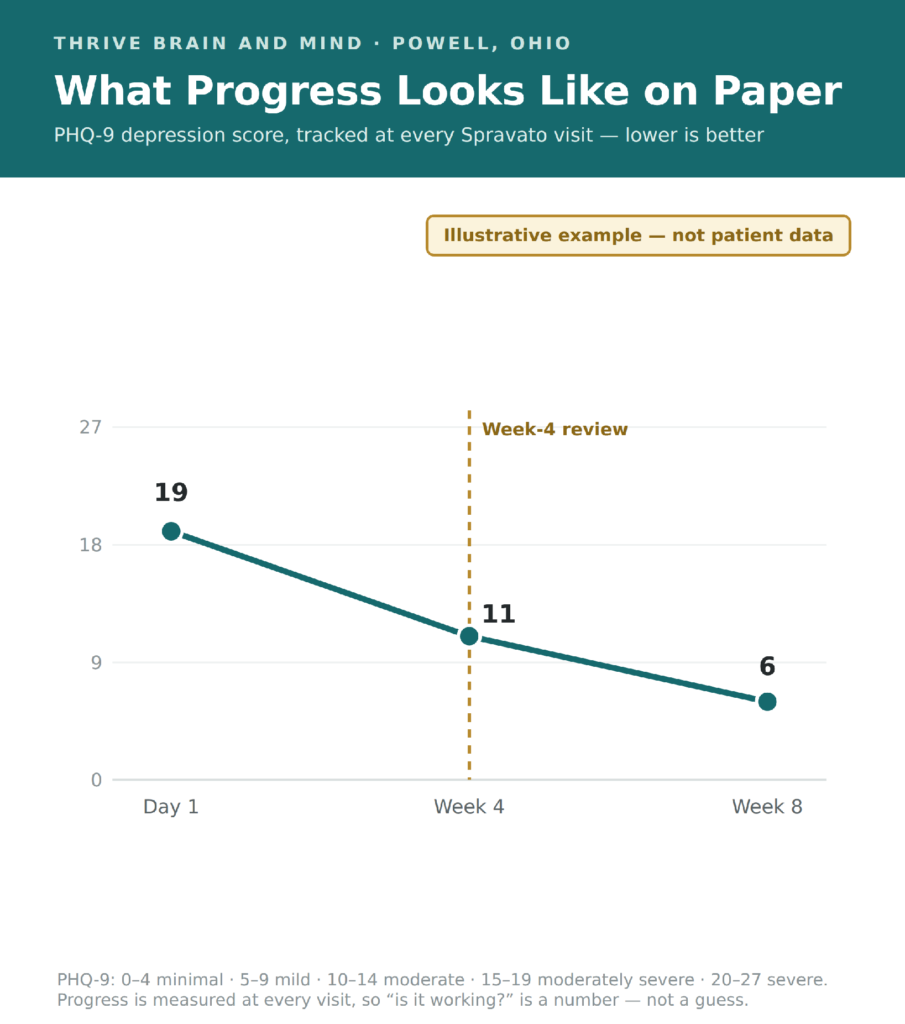
Notice what her story teaches. Recovery usually arrives quietly, and in a particular order: the body first — sleep, appetite, energy — then interest, then mood. The words often catch up last. If you’re at week two feeling “nothing I can name,” you may be exactly where Rachel was.
And if week four comes and your numbers haven’t moved? That’s not failure — that’s information. It tells us to adjust the plan: change the oral antidepressant partner, or pivot to a different mechanism like Transcranial Magnetic Stimulation (TMS) or ketamine injection therapy. Because we offer all three at Thrive Brain and Mind, pivoting is a conversation in the same chair — not a referral, a waitlist, and starting over somewhere new. I’ve written a side-by-side comparison of Spravato, TMS, and ketamine if you want to see the options in one place.
“A timeline is not a test you can fail. It’s a map we read together — and every fork in the road has a next step.”
Why Patients Choose Thrive Brain and Mind for Spravato
- REMS-certified, and built for comfort. We meet the FDA’s strict safety requirements for esketamine, in private treatment rooms designed for a calm two hours — not a hallway recliner.
- You’ll see your own curve. Measurement-based care at every session means you watch your PHQ-9 trend with us. No guessing, no “let’s see how it goes.”
- Experience with the hard cases. I’m Dr. John J. Aziz, a quadruple board-certified psychiatrist with more than 30 years of experience in interventional psychiatry.
- Every option under one roof. Spravato, TMS, and ketamine injection therapy in one practice — so the plan can change without your care ever starting over.
- No surprises. Our team verifies your insurance benefits before day one, and walks you through costs and logistics up front.
We serve patients across the greater Columbus area — Dublin, Westerville, Lewis Center, Delaware, and Upper Arlington — from our REMS-certified clinic at 3785 Attucks Drive in Powell, Ohio, with a second office in Logan. If you’re counting the days and want real answers about your own timeline, let’s look at your curve together.
→ Ask about Spravato at Thrive Brain and Mind — call 614-588-8177 to schedule an evaluation.
Frequently Asked Questions
Can Spravato work after the first session?
Sometimes. In the trial behind the 2025 monotherapy approval, patients showed measurable improvement about 24 hours after the first dose, on average. But many patients feel little or nothing after one session and still go on to respond fully. One session — good or quiet — does not predict your final result.
What if I don’t feel anything after two weeks on Spravato?
Don’t quit — and don’t skip sessions. The induction phase runs four weeks for a reason: the largest group of patients turns the corner in weeks three and four, and early gains are often physical (sleep, appetite, energy) before they’re emotional. Your progress is tracked with the PHQ-9 at every visit, and week four is a formal review where you and your psychiatrist decide the next step together.
Why is my Spravato timeline different from someone else’s?
Because real variables shape the pace: how long and how severe the depression episode has been, how many medications came before, whether an oral antidepressant is used alongside Spravato, how consistent the twice-weekly induction sessions are, sleep quality, alcohol or cannabis use, co-existing conditions, and life stress during treatment. A slower start does not predict a worse outcome.
Do I need to take an antidepressant with Spravato?
It depends on your diagnosis. As of the FDA’s 2025 update, treatment-resistant depression can be treated with Spravato on its own or alongside an oral antidepressant, while major depressive disorder with acute suicidal thoughts or actions is treated with Spravato together with an oral antidepressant. Your evaluation determines the right approach for you.
How long do I stay on Spravato once it works?
After the first two months, sessions typically space out to every one to two weeks, tailored to you. In a year-long study, patients who continued treatment after getting well cut their relapse risk roughly in half compared with those who stopped. How long to continue is an individual decision, revisited regularly with your psychiatrist.
Where can I get Spravato near Columbus, Ohio?
Thrive Brain and Mind in Powell, Ohio is a REMS-certified Spravato treatment center serving the greater Columbus area, with insurance verification before your first visit. TMS and ketamine injection therapy are also available in the same practice if your plan needs to change. Call 614-588-8177 to schedule an evaluation with Dr. John J. Aziz.
This article is for education and is not a substitute for personalized medical advice, diagnosis, or treatment. Individual results and timelines vary — the ranges above describe typical patterns in clinical trials and clinical practice, not a guarantee. Never start or stop a prescription medication without talking to your prescriber. If you are in crisis, call or text 988 — the Suicide & Crisis Lifeline — available 24/7.
RESOURCES & STUDIES CITED
1. Johnson & Johnson. SPRAVATO® (esketamine) approved in the U.S. as the first and only monotherapy for adults with treatment-resistant depression. January 2025. https://www.jnj.com/media-center/press-releases/spravato-esketamine-approved-in-the-u-s-as-the-first-and-only-monotherapy-for-adults-with-treatment-resistant-depression
2. Janssen Pharmaceuticals. SPRAVATO® (esketamine) nasal spray: full prescribing information (dosing schedule, monitoring, and safety requirements). https://www.janssenlabels.com/package-insert/product-monograph/prescribing-information/SPRAVATO-pi.pdf
3. Esketamine monotherapy for treatment-resistant depression: a randomized clinical trial. JAMA Psychiatry. 2025 (published online July 2, 2025). https://jamanetwork.com/journals/jamapsychiatry/fullarticle/2836115
4. Popova V, et al. Efficacy and safety of flexibly dosed esketamine nasal spray combined with a newly initiated oral antidepressant in treatment-resistant depression (TRANSFORM-2). American Journal of Psychiatry. 2019;176(6):428–438. https://pubmed.ncbi.nlm.nih.gov/31109201/
5. Daly EJ, et al. Efficacy of esketamine nasal spray plus oral antidepressant treatment for relapse prevention in patients with treatment-resistant depression (SUSTAIN-1). JAMA Psychiatry. 2019;76(9):893–903. https://pubmed.ncbi.nlm.nih.gov/31166571/