
It’s 12:40 a.m., and you’re doing the thing again: typing “why is my depression not getting better” into a search bar and reading strangers’ answers in the dark. You did what you were supposed to do. You told your family doctor. You started the medication. It helped — some. But a year later, you’re still living at sixty percent: functional at work, flat at home, faking more than you’re feeling. And somewhere in tonight’s scrolling, a question surfaced that you couldn’t quite answer: at what point does this become a psychiatrist’s job?
If that’s you, you’re in the majority. More than a third of American adults have gone online to try to figure out a medical condition on their own. [1] And after 30-plus years as a psychiatrist, I can tell you why so many people stall at this exact fork in the road. It isn’t laziness. It’s three quiet hesitations: “I don’t want to overreact.” “I like my doctor — leaving feels disloyal.” And the big one: “I’m not sick enough for a psychiatrist.”
A patient I’ll call David (details changed to protect privacy) — a 51-year-old sales manager — carried all three for two years. Two years of a medication that took the edge off but never gave him back his mornings, his motivation, or the easy laughter in his marriage. When he finally sat down in my office, his first words were an apology: “I probably shouldn’t even be here. It’s not that bad.” One thorough evaluation found what two years of quick check-ins couldn’t. More on David in a minute.
““Not sick enough for a psychiatrist” is the most expensive sentence in mental health. It costs people years.”
First, Some Respect for Your Family Doctor
Let me say something you might not expect from a specialist: I love primary care doctors. They are the front line of American medicine. They catch the diabetes, the blood pressure, and the depression that nobody else was going to catch. Most depression care in this country happens in their offices — about four out of five antidepressant prescriptions are written by someone other than a psychiatrist, most often a primary care doctor. [2] For a first episode of mild to moderate depression, starting there is reasonable. Often, it works.
But look at the math your doctor is working against. The average primary care visit runs about 15 minutes and covers six different health topics. [3] That’s the blood pressure, the cholesterol, the knee, the refill — and your mood, in whatever minutes are left. Your family doctor isn’t failing you. They’re playing the position they were built for. The real question is whether your depression still fits inside that 15-minute box.
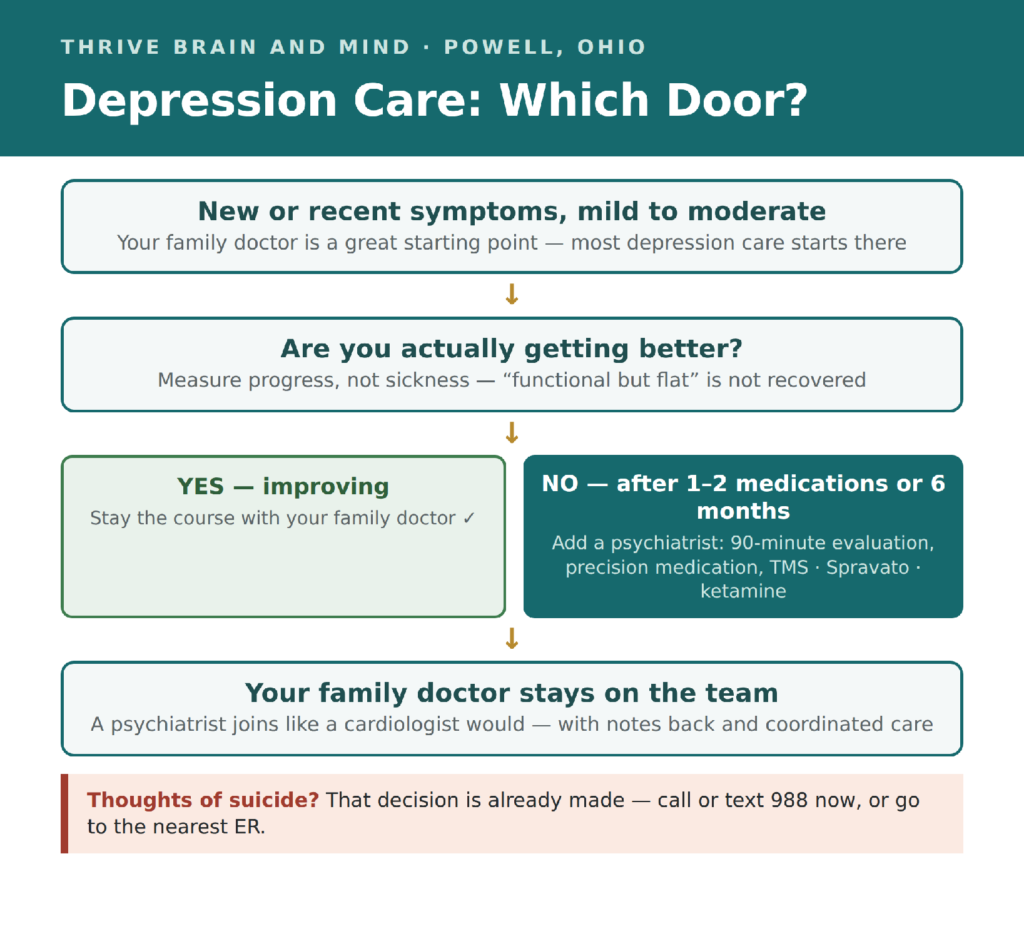
Think of it like your heart. Your family doctor treats blood pressure every single day. But when the rhythm turns strange, they don’t keep guessing — they send you to a cardiologist. Depression deserves the same escalation path. Yet with mood, people wait: the typical delay between first symptoms and first treatment is close to a decade [4] — and in my experience, once treatment stalls, the wait to see a specialist can stretch nearly as long.
Your Task: Stop Measuring Sickness. Start Measuring Progress.
Here’s the mental shift that unlocks this whole decision. Most people ask, “Am I sick enough for a psychiatrist?” That’s the wrong question. The better one: “Am I actually getting better on my current path?” Specialists aren’t reserved for the “worst” cases. They’re for the stuck ones.
- Don’t quit your medication while you decide. Stopping abruptly can trigger discontinuation symptoms and a rebound. Whatever comes next builds on where you are now.
- Don’t keep white-knuckling “functional but flat.” Sixty percent is not recovered. You do not have to earn specialist care by getting worse first.
- Do run the eight-sign checklist below. Check even one box, and an evaluation is warranted. Two or more? Make the call this week.
And one thing outranks the whole framework: if you’re having thoughts of suicide, the decision is already made. Call or text 988, the Suicide & Crisis Lifeline, right now, or go to the nearest emergency room.
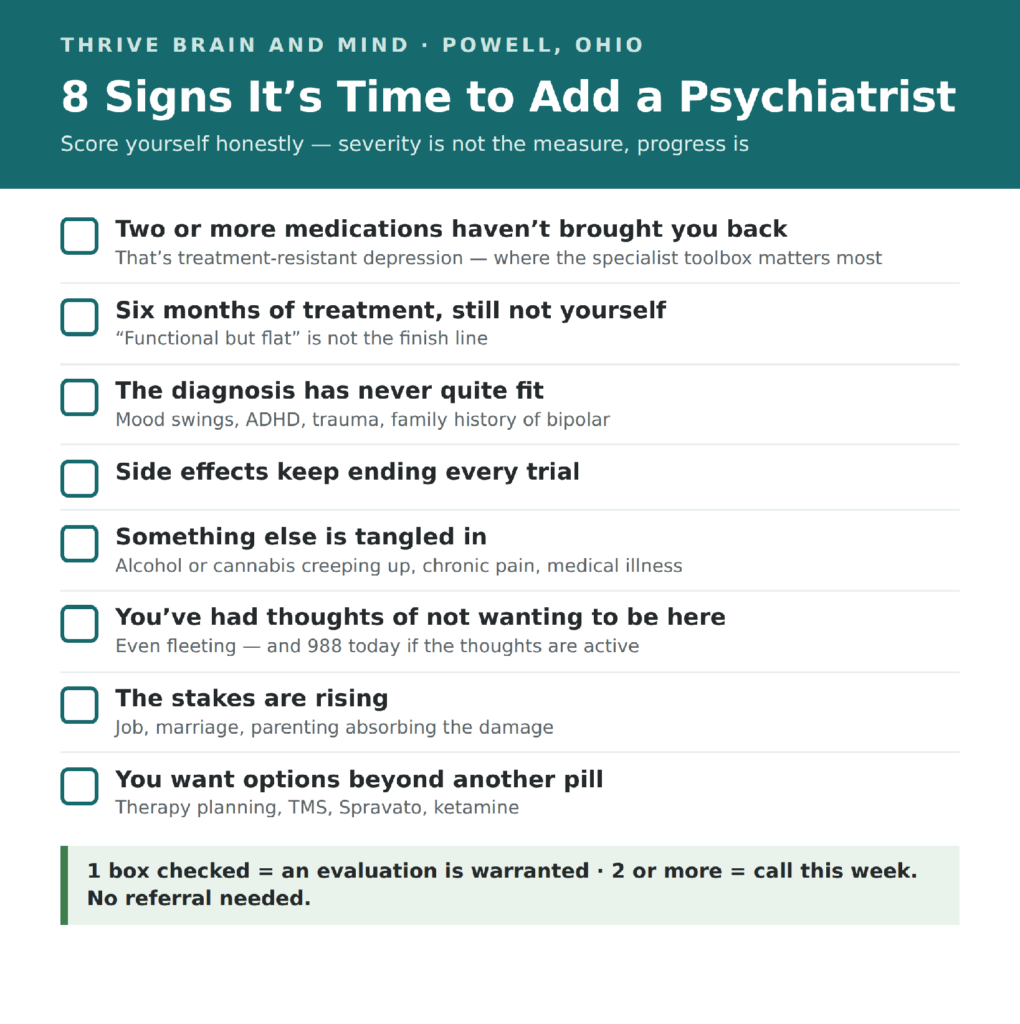
The Checklist: 8 Signs It’s Time to Add a Psychiatrist
In my practice, these are the eight situations where specialist care changes the story. Score yourself honestly.
- Two or more medications haven’t brought you back. That’s the working definition of treatment-resistant depression (TRD) — roughly 30 percent of treated adults reach this point [5] — and it’s exactly where a psychiatrist’s toolbox matters most.
- Six months of treatment, and you’re still not yourself. “Functional but flat” — better but not well — is the most under-treated condition I see. It is not the finish line.
- The diagnosis has never quite fit. Energy swings, racing-thought weeks, a family history of bipolar disorder, possible attention-deficit/hyperactivity disorder (ADHD), old trauma. Antidepressants alone can make unrecognized bipolar disorder worse — sorting this out is a specialist’s core job.
- Side effects keep ending every trial. If every medication “works, but…” — the weight, the fog, the numbness — your medication strategy needs a specialist’s precision.
- Something else is tangled in. Alcohol or cannabis quietly creeping up, chronic pain, a medical illness, an eating pattern. Layered conditions need one clinician who can see the whole board.
- You’ve had thoughts of not wanting to be here. Even fleeting. Even “passive.” This always warrants specialist care — and 988 today if the thoughts are active.
- The stakes are rising. Your job, your marriage, your parenting are absorbing the damage. When another flat year costs this much, trial-and-error pacing stops being acceptable.
- You want options beyond another pill. Structured therapy planning, Transcranial Magnetic Stimulation (TMS), Spravato (esketamine), ketamine injection therapy. These options exist — and most primary care offices simply can’t offer them.
| Stay the course with your family doctor when… | Add a psychiatrist when… |
|---|---|
| It’s a first episode, mild to moderate, and it started recently | You’ve cycled through two or more medications without getting well |
| The first medication is clearly helping, and you’re still improving | Six-plus months in, you’re stuck at “functional but flat” |
| The diagnosis is straightforward and nothing else is tangled in | Mood swings, trauma, ADHD, substance use, or a family history of bipolar disorder blur the picture |
| Life is still running — work, home, and relationships intact | Work, marriage, or parenting are taking real damage |
| No safety concerns | Any thoughts of suicide — or you want options beyond pills, like TMS or Spravato |
One column is not “worse” than the other — they’re different stages of the same illness, and moving between them is normal medical care.
What a Psychiatrist Actually Adds — and What Happens to Your Family Doctor
“Add” is the key word. A psychiatrist doesn’t replace your primary care doctor — we join the team, the way a cardiologist joins for your heart. Your doctor keeps the whole-body view. I take the deep dive on the mind. And with your permission, we work connected: after an evaluation at Thrive Brain and Mind, we send your family doctor the plan, coordinate any medication changes with what they’re managing, and keep them in the loop at every major decision. Some of my longest relationships with Columbus-area physicians started exactly this way — a shared patient, finally getting better.
So what does the deep dive look like? Time, first — and I mean real time. A new-patient evaluation at our practice runs about 90 minutes. That’s six 15-minute visits’ worth of attention, on one problem, in one sitting. We re-take the whole story: every medication, every dose, every “almost worked.” We screen for the look-alikes and the tangles — the bipolar spectrum, ADHD, trauma, substance use, thyroid and other medical mimics. We measure progress with standardized tools like the Patient Health Questionnaire-9 (PHQ-9), so improvement becomes a number you can watch, not a feeling you have to guess about. And we bring the full toolbox: therapy, precision medication strategies, and interventional options — TMS, Spravato, and ketamine injection therapy — for depression that has already outlasted the standard playbook. After that, follow-ups are focused on 30-minute visits, in the clinic or by telemedicine, so adjustments never have to wait for next year’s physical. No referral is needed: you can call us directly, and our team verifies your insurance before your first visit.
“Your family doctor plays offense on your whole health. I play deep on one thing: getting your mind back. Patients do best when we’re on the field together.”
The Results: What David Found in One Appointment
Back to David and his apology. His new-patient evaluation ran the full 90 minutes, and it surfaced two things two years of hurried check-ins never could. First: stretches in his late 30s of racing energy and three-hour nights — which made “just an antidepressant” the wrong tool, because his depression lived on the bipolar spectrum. Second: a nightly six-pack he’d never mentioned, because no one had time to ask. We corrected the diagnosis, rebuilt the medication plan around it, treated the drinking as part of the picture instead of a separate embarrassment, and added structured therapy. Two weeks later, his wife noticed the change before he did. At six months, he gave me the sentence I’d frame if I could: “I didn’t know this much better was on the menu.”
That’s one man’s story, and yours will run on its own clock — no two recoveries match. But the pattern holds in the data: in the largest depression treatment study ever run, patients who kept stepping up through evidence-based levels of care — rather than repeating the same level and hoping — reached remission about two-thirds of the time. [6] The step is the treatment. Staying stuck is the only true failure mode.
And David’s family doctor? Still his family doctor — for everything a family doctor is brilliant at. He just doesn’t have to solve treatment-resistant depression in the last four minutes of a physical anymore.
Why Patients — and Their Doctors — Choose Thrive Brain and Mind
- Specialist depth without the runaround. A thorough 90-minute new-patient evaluation, a clear diagnosis in plain language, and a written plan — then focused 30-minute follow-ups, in the clinic or by telemedicine. Shared with your primary care doctor whenever you want us connected.
- The full toolbox in one practice. Therapy, medication management, TMS, Spravato — we are a Risk Evaluation and Mitigation Strategy (REMS)-certified treatment center — and ketamine injection therapy. If the plan needs to change, it changes in the same chair.
- Experience for the tangled cases. I’m Dr. John J. Aziz, a quadruple board-certified psychiatrist with more than 30 years of experience — including board certification in addiction medicine, for the cases where alcohol or substances are part of the knot.
- Care for the whole family. Children, adolescents, and adults — because depression rarely lives in just one chair at the dinner table.
- No referral needed. Call directly. Insurance verified before your first visit. Telehealth available for select evaluations.
We serve patients across the greater Columbus area — Dublin, Westerville, Lewis Center, Delaware, and Upper Arlington — from our clinic at 3785 Attucks Drive in Powell, Ohio, with a second office in Logan. And to referring physicians reading this: we welcome your patients, we report back promptly, and we send them back to you better.
→ Schedule an evaluation at Thrive Brain and Mind — call 614-588-8177. No referral needed.
Frequently Asked Questions
Should I see a psychiatrist or my regular doctor for depression?
For a recent, first episode of mild to moderate depression, your primary care doctor is a reasonable starting point. It’s time to add a psychiatrist when two or more medications haven’t worked, when you’ve been treated six months or more without feeling like yourself, when the diagnosis is unclear, or when anything else — substance use, trauma, safety concerns — complicates the picture.
Do I need a referral to see a psychiatrist?
At Thrive Brain and Mind, no. You can call our office directly at 614-588-8177 and our team verifies your insurance benefits before your first visit. If your family doctor wants to send a referral, we welcome it — but you don’t have to wait for one.
Will a psychiatrist replace my primary care doctor?
No. A psychiatrist joins your care team the way a cardiologist would — as a specialist for one domain. Your primary care doctor continues managing your overall health, and with your permission, we share our evaluation and treatment plan with them and coordinate every major decision.
What can a psychiatrist do that my primary care doctor can’t?
Dedicated time, first: a new-patient evaluation at Thrive Brain and Mind runs about 90 minutes, with focused 30-minute follow-ups in clinic or by telemedicine. That time buys screening for conditions that mimic or complicate depression (like bipolar disorder or ADHD), precision medication strategies after failed trials, measurement-based tracking of your progress, and access to interventional treatments — Transcranial Magnetic Stimulation (TMS), Spravato (esketamine), and ketamine injection therapy — that most primary care offices cannot offer.
How do I know if my depression is “bad enough” to see a psychiatrist?
“Bad enough” is the wrong measure — progress is the right one. If you’ve tried two or more medications, or you’ve been in treatment six months and still don’t feel like yourself, an evaluation is warranted no matter how “functional” you look. And any thoughts of suicide always warrant specialist care — call or text 988 right away if those thoughts are active.
Where can I see a psychiatrist near Columbus, Ohio without a referral?
Thrive Brain and Mind in Powell, Ohio sees children, adolescents, and adults across the greater Columbus area with no referral required. Evaluations, therapy, medication management, TMS, Spravato, and ketamine injection therapy are all available in one practice. Call 614-588-8177 to schedule with Dr. John J. Aziz.
This article is for education and is not a substitute for personalized medical advice, diagnosis, or treatment. Individual situations and results vary — the guidance above describes common patterns, not rules that fit every person. Never start or stop a prescription medication without talking to your prescriber. If you are in crisis, call or text 988 — the Suicide & Crisis Lifeline — available 24/7.
RESOURCES & STUDIES CITED
1. Pew Research Center. Health Online 2013 — 35% of U.S. adults have gone online to figure out a medical condition. https://www.pewresearch.org/internet/2013/01/15/health-online-2013/
2. Mark TL, Levit KR, Buck JA. Datapoints: psychotropic drug prescriptions by medical specialty. Psychiatric Services. 2009;60(9):1167. https://psychiatryonline.org/doi/10.1176/ps.2009.60.9.1167
3. Tai-Seale M, McGuire TG, Zhang W. Time allocation in primary care office visits. Health Services Research. 2007;42(5):1871–1894. https://pubmed.ncbi.nlm.nih.gov/17850524/
4. Wang PS, et al. Failure and delay in initial treatment contact after first onset of mental disorders in the National Comorbidity Survey Replication. Archives of General Psychiatry. 2005;62(6):603–613. https://pubmed.ncbi.nlm.nih.gov/15939838/
5. Zhdanava M, et al. The prevalence and national burden of treatment-resistant depression and major depressive disorder in the United States. Journal of Clinical Psychiatry. 2021;82(2):20m13699. https://pubmed.ncbi.nlm.nih.gov/33989464/
6. Rush AJ, et al. Acute and longer-term outcomes in depressed outpatients requiring one or several treatment steps: a STAR*D report. American Journal of Psychiatry. 2006;163(11):1905–1917. https://psychiatryonline.org/doi/10.1176/ajp.2006.163.11.1905