Your first Transcranial Magnetic Stimulation (TMS) appointment is Thursday. Which is why it’s 11:30 on Tuesday night and you’re searching “what does TMS feel like” with your stomach in a knot. Magnets. Your brain. It sounds like science fiction, and nobody you know has done it. Part of you is hopeful — two medications didn’t get you better, and your psychiatrist believes this can. The other part is quietly wondering whether to cancel.
Meet a patient I’ll call Linda (details changed to protect privacy) — a 61-year-old retired schoolteacher who almost did cancel. Her word for it was “zapping.” She sat in my office, arms crossed, and said: “You want to zap my brain, Dr. Aziz.” What changed her mind wasn’t a pep talk. It was a five-minute walkthrough of exactly what happens in the chair — the same walkthrough I’m about to give you.
Because here’s what 30-plus years of psychiatry have taught me about fear: it lives in the blanks. Fill in the blanks, and fear shrinks to fit the facts. And the facts about TMS are friendlier than almost anyone expects: no medication, no needles, no sedation, no downtime. You drive yourself home. Let’s walk through your first appointment, minute by minute.
“Nobody cancels TMS after truly understanding it. They cancel because of the picture in their head — and that picture is almost always wrong.”
What TMS Is — and What It Isn’t
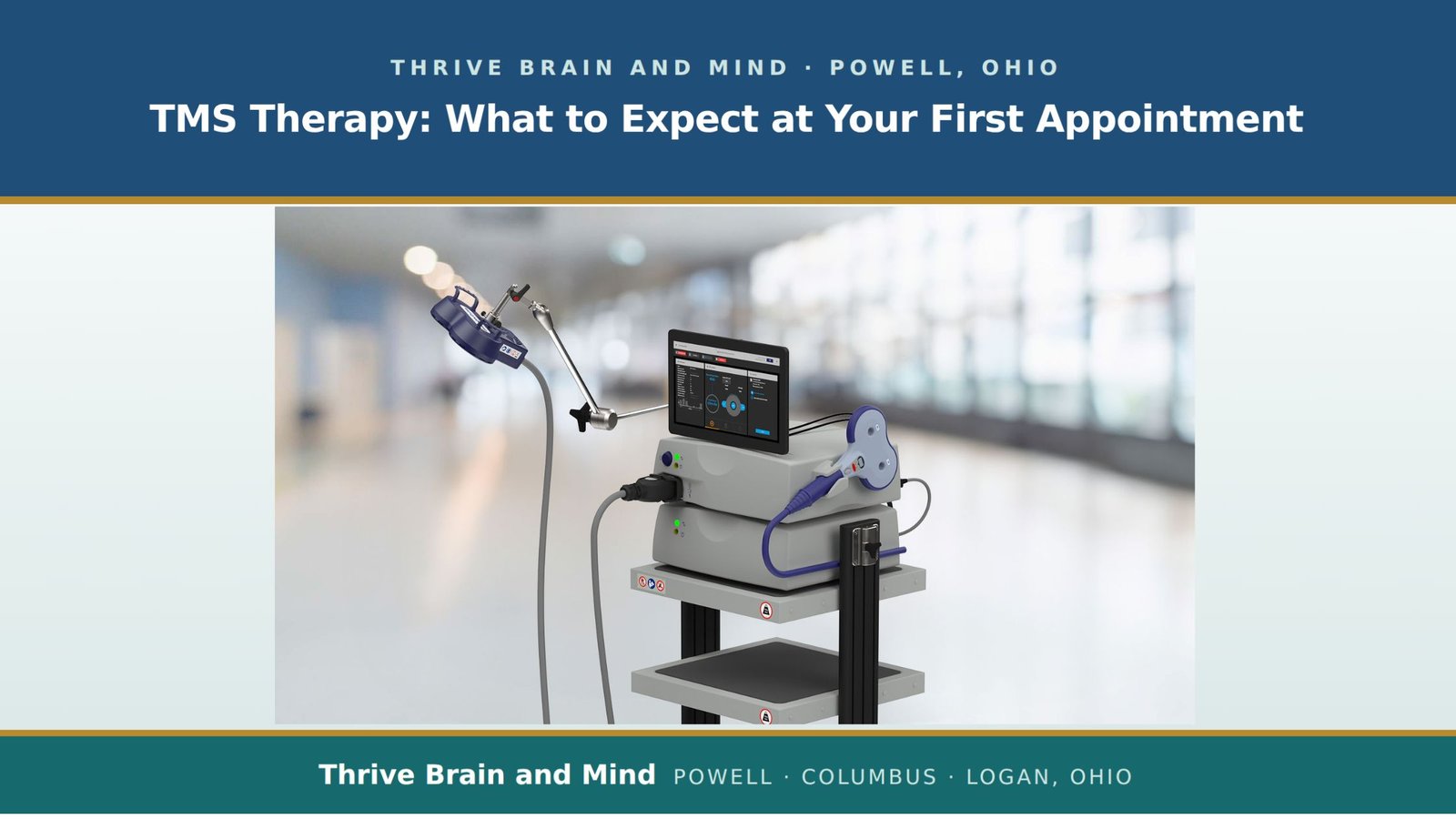
TMS is a treatment cleared by the U.S. Food and Drug Administration (FDA) that uses focused magnetic pulses — the same kind of magnetic field an MRI machine uses — to gently stimulate the brain’s mood circuits, mainly the prefrontal cortex, which runs underactive in depression. Delivered over a course of sessions (about 36 is typical [1]), that repeated stimulation helps those circuits fire the way they’re supposed to again. Think of it as physical therapy for the brain. At our clinic, we treat on the Magstim system — technology from the company that built some of the earliest TMS devices used in brain research, now used in clinics and universities worldwide.
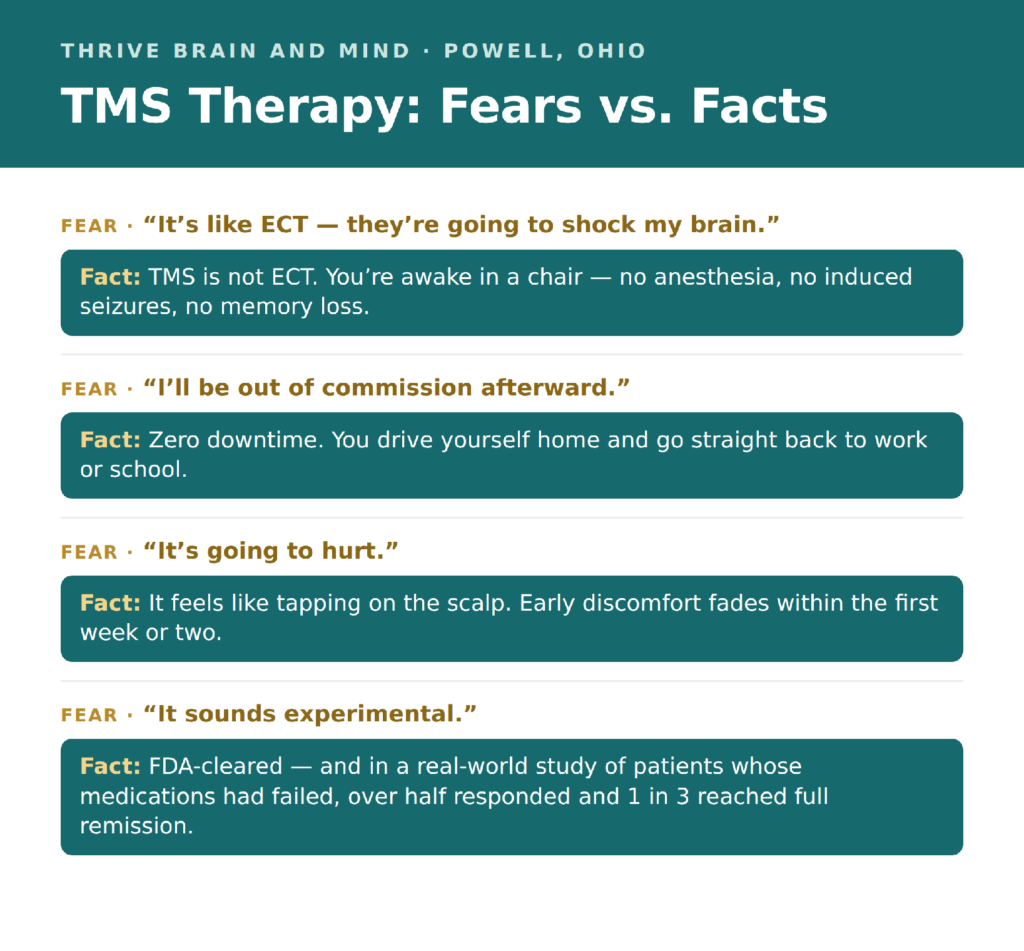
Now let’s clear up the biggest misunderstanding in this field. TMS is not electroconvulsive therapy (ECT). ECT is a different treatment — a valuable one for the most severe cases — that involves anesthesia and medically induced seizure activity in a hospital setting. TMS involves none of that. You are awake. You are alert. Nothing “shocks” you. There is no anesthesia, no memory loss, and no recovery period. You walk in, sit in a comfortable chair for a while, and walk out — to your car, your job, your grandkids’ soccer game.
Your To-Do List Before Day One: Refreshingly Short
Some treatments ask a lot of you. TMS asks almost nothing. Here is the entire list:
- Come as you are. Eat normally, take your medications as usual, drink your coffee. No fasting, no ride needed — you’ll drive yourself home.
- Tell us about metal. At your evaluation, we screen carefully for metal implants in or near the head — certain implants and a history of seizures are the main reasons TMS isn’t a fit. Everyday jewelry and hair clips simply come off before each session.
- Bring your questions — and your playlist. You’ll be awake the whole time. Many patients listen to music, watch TV, or chat with the technician.
- Don’t cancel out of fear. If the picture in your head is scarier than this article, bring the fear to the appointment. I’d rather answer it face to face than have you lose another season to depression.
And one thing outranks the whole plan: if thoughts of suicide show up while you’re waiting for any treatment to work, call or text 988, the Suicide & Crisis Lifeline, right away, or go to the nearest emergency room.
Your First Appointment, Step by Step
At Thrive Brain and Mind, TMS starts only after a thorough evaluation — about 90 minutes with me, not a form and a handshake — where we confirm TMS is right for you and our team verifies your insurance coverage. Then comes the visit you’re probably nervous about: mapping day. Plan for roughly an hour to 90 minutes. Here’s the play-by-play.
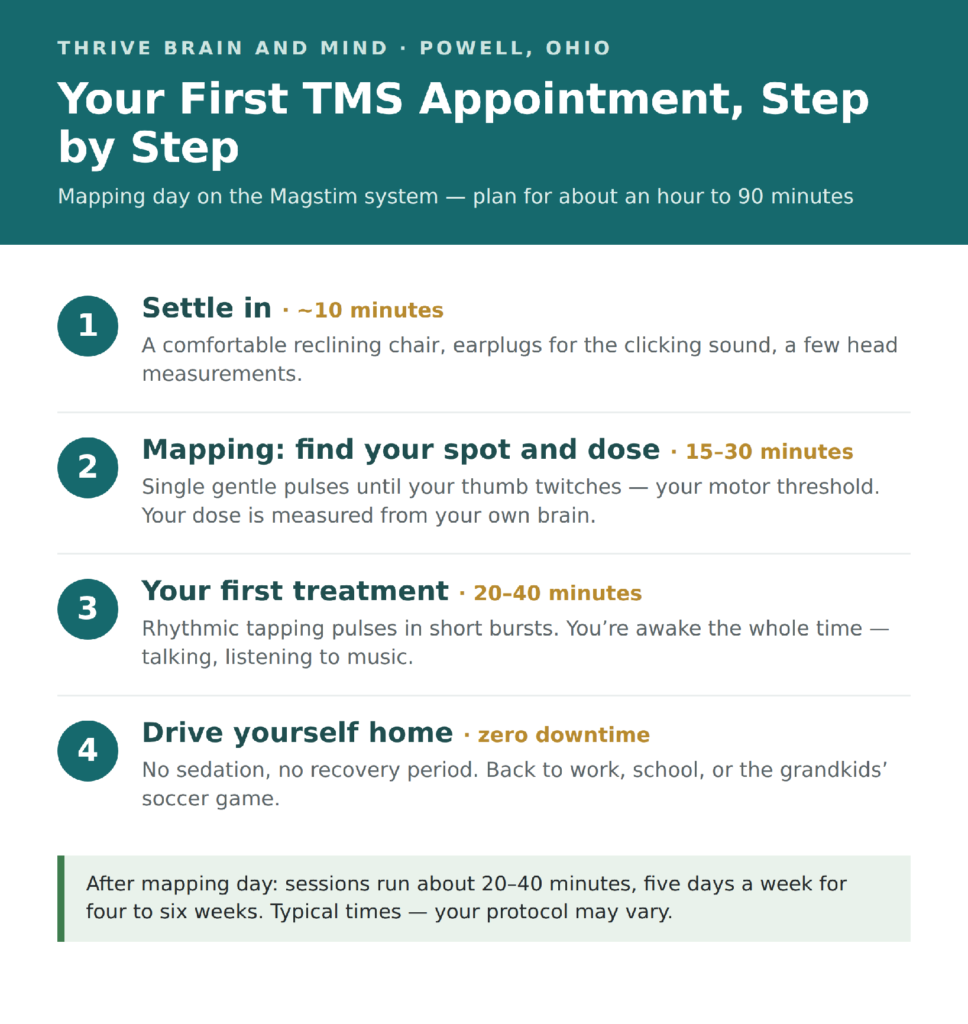
Step 1 — Settle in (about 10 minutes)
You sit in a padded reclining chair — patients tell me it lands somewhere between a dentist’s chair and a first-class seat. You get earplugs, because the machine makes a loud clicking sound, and we take a few head measurements, sometimes with a soft cap, to begin locating your treatment spot.
Step 2 — Mapping: we find your spot and your dose (15–30 minutes)
This is what makes day one special. We rest the magnetic coil against your scalp and deliver single, gentle pulses over the motor area of your brain — and we watch your hand. When your thumb twitches, we’ve found your motor threshold: the precise amount of energy your brain responds to. That number personalizes your entire course of treatment. Your dose isn’t a guess. It’s measured — from your own brain, on day one.
Step 3 — Your first treatment (about 20–40 minutes)
The coil moves to the prefrontal target and treatment begins: rhythmic tapping pulses in short bursts, with rests in between. Patients describe it as a woodpecker tapping on the scalp — strange for the first few minutes, then background noise. You’re awake and fully yourself the entire time. Talking. Listening to music. Watching the clock less than you expected to.
Step 4 — Stand up and go live your day (zero downtime)
That’s not a typo. When the session ends, you stand up and leave. Drive yourself. Go back to work. Pick up the kids. There’s no sedation to wear off and no monitoring period. Of every treatment I offer, TMS interferes least with a normal life.
What about side effects?
The honest list is short. Early on, many patients feel some scalp discomfort at the treatment site or a mild headache afterward — it fades over the first week or two as your body gets used to the sensation, and an over-the-counter pain reliever handles it. The serious risk people read about — seizure — is real but extremely rare: in a survey covering more than half a million treatment sessions, seizures occurred roughly once in every 30,000 sessions, [2] and our screening is designed to keep anyone at genuine risk out of the chair in the first place. There’s no memory loss and no thinking fog with TMS. That’s exactly why you can drive yourself home.
| Step | What happens | About how long |
|---|---|---|
| Settle in | Comfortable reclining chair, earplugs, head measurements | ~10 minutes |
| Mapping | Single test pulses find your motor threshold — the thumb twitch that personalizes your dose | 15–30 minutes |
| First treatment | Tapping pulses in short bursts at the prefrontal target; you’re awake the whole time | 20–40 minutes |
| Afterward | Stand up, drive yourself, return to your normal day | Zero downtime |
Daily sessions after mapping day are shorter — about 20 to 40 minutes door to door. Times are typical and may vary with your protocol.
After Day One: The Rhythm
From there, TMS becomes routine fast: a session five days a week for four to six weeks, then a taper at the end of the course. [1] Most patients fold it into their day like a gym stop — before work, on a lunch break. By week two, Linda was bringing her knitting. By week three, the technician knew her grandkids’ names. The chair stopped being scary and became twenty quiet minutes with a magazine.
The Results: What to Expect — and When
Now, the question behind the question: when will you feel it? Honest answer — TMS builds slowly. Most patients who respond notice the turn around weeks four to six; some feel movement earlier, and some are still climbing after the course ends. Everyone’s clock runs a little differently, and the usual variables apply: how long the episode has lasted, how many medications came before, sleep, alcohol, other conditions, and how steadily you keep the five-day rhythm. A quiet week two predicts nothing. We track your progress at every stage with a standardized checklist — the Patient Health Questionnaire-9 (PHQ-9) — so “is it working?” is a number we watch together, not a feeling you have to guess about.
And the numbers are worth the patience. In a real-world, multisite study of patients whose medications had failed, 58 percent responded to TMS and 37 percent reached full remission. [3] Even better, the results tend to last: in a year-long follow-up, about two out of three responders were still doing well 12 months later. [4] That durability is why I call TMS the tortoise — slower to start, built to stay.
Linda’s turn came at week five. She noticed she had rejoined her book club before she noticed her mood had lifted — recovery usually shows up in your calendar before it shows up in your words. At her one-year check-in, she was still herself. Her line, which I now pass along to every nervous first-timer: “The scariest part of TMS was the night before the first appointment. After that, it was parking.”
One more thing many families don’t know: TMS is now FDA-cleared as an add-on treatment for adolescents 15 and older with depression — and in 2025, that clearance was extended to the Magstim system, the exact platform we treat on. [5] Very few practices in central Ohio offer TMS to teenagers. We do — with the same careful screening and family involvement you’d expect.
“TMS is the tortoise in this race. Slower to start working — but in my experience, the results tend to stick. And in depression care, sticking is everything.”
TMS in Powell and Columbus, Ohio: Why Thrive Brain and Mind
- A psychiatrist-led Magstim program. Your course is prescribed, mapped, and monitored under me — Dr. John J. Aziz, a quadruple board-certified psychiatrist with more than 30 years of experience — not run at arm’s length.
- Every option under one roof. If TMS isn’t your best fit — or you want to weigh it against Spravato (esketamine) or ketamine injection therapy — the comparison and the treatment happen in the same practice, with no starting over.
- Measurement, not vibes. A 90-minute evaluation before anything starts, and PHQ-9 tracking at every stage of your course.
- All ages. Adults — and adolescents 15 and older as an add-on treatment, which few central Ohio practices offer.
- No referral needed, no coverage surprises. Call directly. Most insurance plans cover TMS when medications haven’t worked, and our team verifies your specific benefits before you commit to anything.
We provide TMS at our clinic at 3785 Attucks Drive in Powell, Ohio — serving the greater Columbus area, including Dublin, Westerville, Lewis Center, Delaware, and Upper Arlington — with a second office in Logan for southeastern Ohio. If you’ve been circling this decision, come fill in the blanks. Once the picture in your head is accurate, you can decide with confidence.
→ Ask about TMS at Thrive Brain and Mind — call 614-588-8177. No referral needed.
Frequently Asked Questions
Does TMS hurt?
Most patients describe it as a tapping sensation on the scalp — odd at first, then easy to ignore. Some feel scalp discomfort or a mild headache in the first week or two; it fades as you adjust, and an over-the-counter pain reliever handles it. You wear earplugs because the machine clicks loudly. Most people spend sessions listening to music, watching TV, or chatting.
Is TMS the same as ECT (electroconvulsive therapy)?
No. ECT is a different treatment — valuable for the most severe cases — that uses anesthesia and induced seizure activity in a hospital setting. TMS uses magnetic pulses while you sit awake in a chair: no anesthesia, no induced seizures, no memory loss, and no recovery time. You drive yourself home after every session.
Can I drive home after a TMS session?
Yes. TMS involves no sedation and no impairment, so you can drive yourself to and from every appointment and return immediately to work, school, or normal activities.
How long is each TMS session, and how many will I need?
Your first visit — mapping day — runs about an hour to 90 minutes, because we measure your personal treatment spot and dose. After that, sessions run about 20 to 40 minutes, five days a week for four to six weeks (a full course is typically around 36 sessions), followed by a short taper.
Does insurance cover TMS in Ohio?
Most commercial insurance plans and Medicare cover TMS for depression when medications haven’t worked — typically requiring documented antidepressant trials, which most TMS candidates already have. At Thrive Brain and Mind, our team verifies your specific benefits before treatment begins, so there are no surprises.
Where can I get TMS therapy near Columbus, Ohio?
Thrive Brain and Mind offers psychiatrist-led TMS on the Magstim system at our Powell, Ohio clinic, serving the greater Columbus area, with a second office in Logan. We treat adults — and adolescents 15 and older as an add-on treatment. No referral is needed: call 614-588-8177 to schedule an evaluation with Dr. John J. Aziz.
This article is for education and is not a substitute for personalized medical advice, diagnosis, or treatment. Individual results and timelines vary — the ranges above describe typical patterns in clinical trials and clinical practice, not a guarantee. Candidacy for TMS is determined by a full psychiatric evaluation. If you are in crisis, call or text 988 — the Suicide & Crisis Lifeline — available 24/7.
RESOURCES & STUDIES CITED
1. Perera T, et al. The Clinical TMS Society consensus review and treatment recommendations for TMS therapy for major depressive disorder. Brain Stimulation. 2016;9(3):336–346. https://pubmed.ncbi.nlm.nih.gov/27090022/
2. Seizure risk with repetitive TMS: survey results from over a half-million treatment sessions. Brain Stimulation. 2021;14(4):965–973. https://www.brainstimjrnl.com/article/S1935-861X(21)00118-2/fulltext
3. Carpenter LL, et al. Transcranial magnetic stimulation (TMS) for major depression: a multisite, naturalistic, observational study of acute treatment outcomes in clinical practice. Depression and Anxiety. 2012;29(7):587–596. https://onlinelibrary.wiley.com/doi/abs/10.1002/da.21969
4. Dunner DL, et al. A multisite, naturalistic, observational study of transcranial magnetic stimulation for patients with pharmacoresistant major depressive disorder: durability of benefit over a 1-year follow-up period. Journal of Clinical Psychiatry. 2014;75(12):1394–1401. https://www.psychiatrist.com/jcp/multisite-naturalistic-observational-study-transcranial/
5. Magstim. New FDA clearance for TMS treatment in U.S. adolescent patients (ages 15 and older, adjunct treatment). March 2025. https://www.magstim.com/magstim-new-fda-clearance-for-tms-treatment-in-us-adolescent-patients/
6. National Institute of Mental Health. Brain stimulation therapies (patient and family overview — additional resource, not cited in text). https://www.nimh.nih.gov/health/topics/brain-stimulation-therapies