
Your first appointment at Thrive Brain and Mind is Thursday at 10 a.m. You’ve planned the drive. You’ve picked what you’ll wear. And now it’s 11:40 on a Tuesday night and you’re searching “what happens at a psychiatric evaluation” — because the truth is, you have no idea what you’ve signed up for. Will there be a couch? Will they dig through your childhood? Will you cry in front of a stranger? Will you walk out with a diagnosis you’re not ready for — or a prescription you didn’t ask for?
Let me tell you about a patient I’ll call Emily (details changed to protect privacy) — 29, a marketing coordinator, sharp and funny and quietly miserable. She rescheduled her first appointment twice. Not because she was busy. Because not knowing what would happen in that room scared her more than the anxiety she was coming in for. After the visit finally happened, she said something I’ve heard, in some form, hundreds of times: “I talked for an hour and nobody flinched. Why did I wait a year for that?”
So this post does one simple thing: it removes the unknown. Here is exactly what happens in a new-patient evaluation at our practice — all 90 minutes of it — the questions we ask, why we ask them, and what you leave with. After 30-plus years of first appointments, I can promise you the reality is gentler than whatever your 11:40 p.m. brain is projecting.
“Nobody has ever told me a story I couldn’t hear. In this room, your worst day is a Tuesday.”
First: What a Psychiatric Evaluation Is NOT
Most first-appointment fear comes from television and old movies. So before the walkthrough, let’s clear the set:
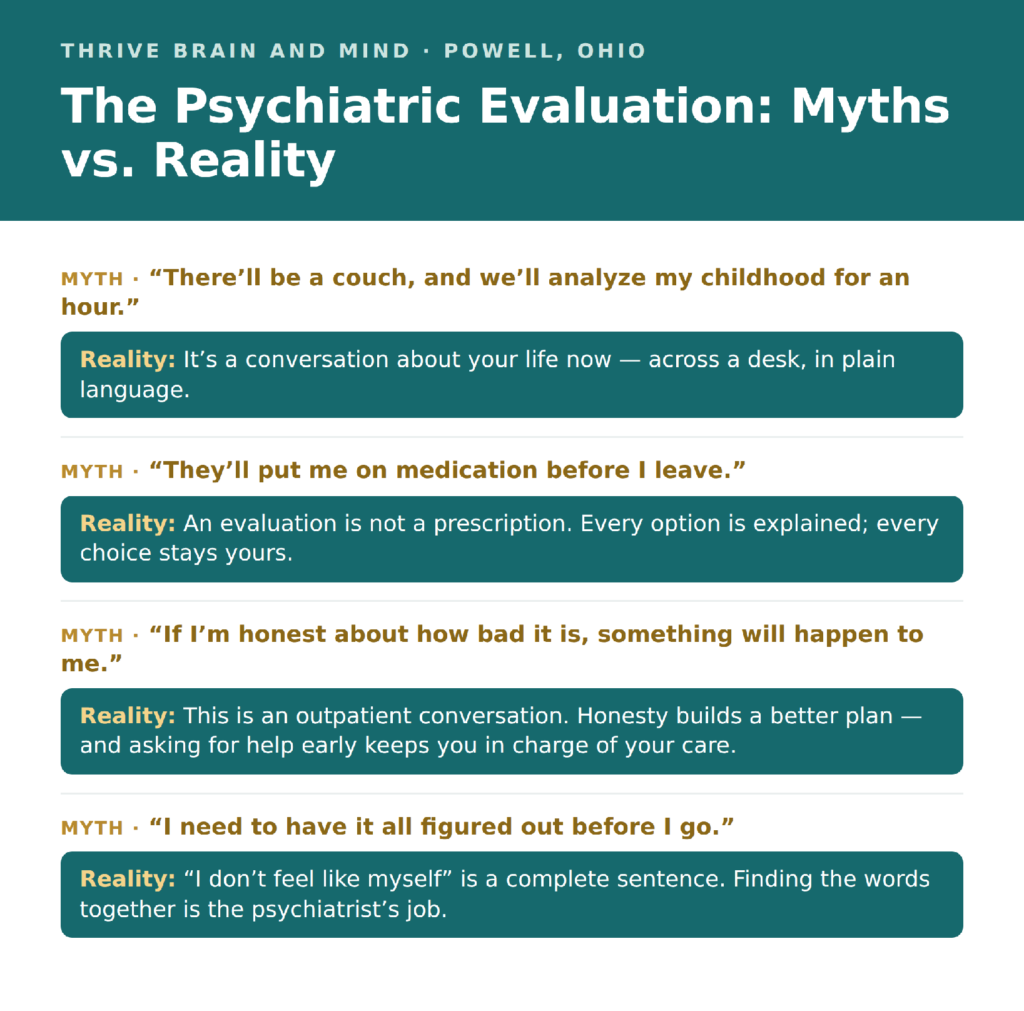
- It’s not an analysis couch. No couch. No inkblots. It’s a conversation about your life now, across a desk, in plain language.
- It’s not an automatic prescription. An evaluation is not a prescription. Every option gets explained — therapy, medication, and beyond — and every choice stays yours. Nothing starts without your consent.
- It’s not a trap. This is an outpatient conversation. Being honest about how dark things have felt builds you a better plan — and asking for help early is exactly how you stay in charge of your own care.
- It’s not a test you can fail. You don’t need the right words, a theory about yourself, or a tidy story. “I don’t feel like myself” is a complete sentence. Finding the words together is my job, not your homework.
Your Task Before Thursday: A Refreshingly Short List
Preparation for a psychiatric evaluation is almost embarrassingly simple. Here’s everything:
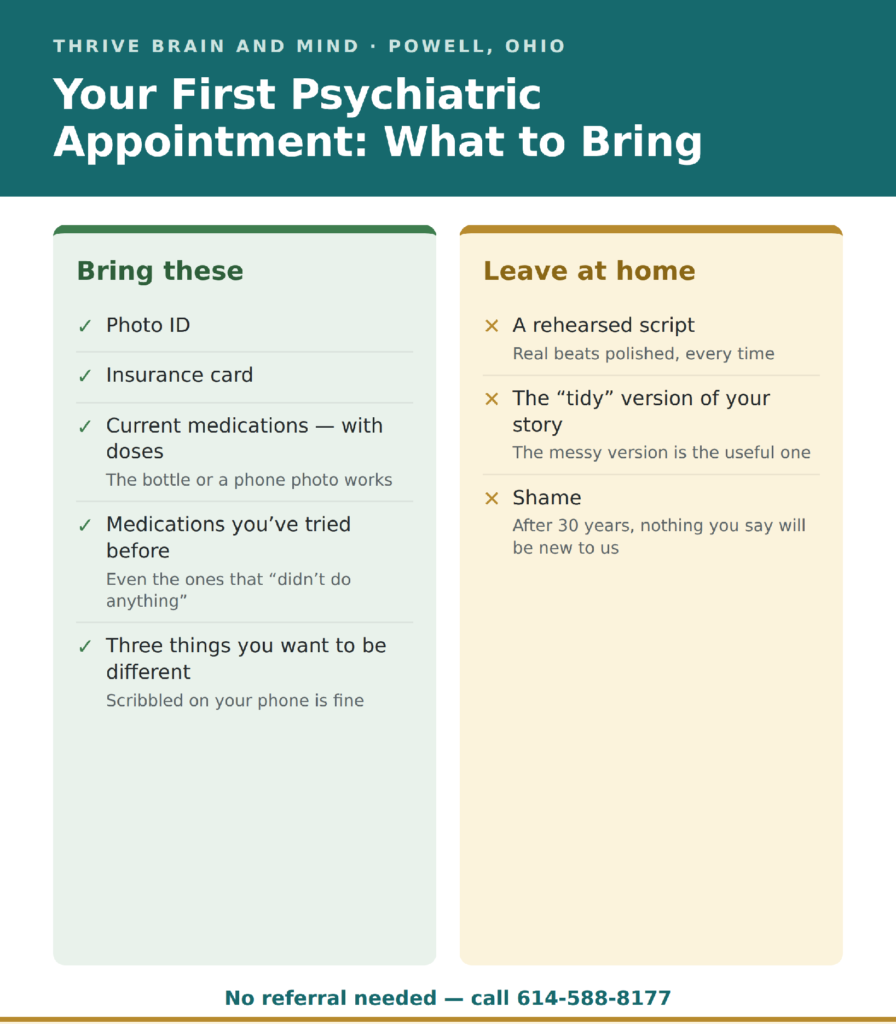
- Bring the practical items. Photo ID, your insurance card, your current medications with doses (the bottles or a phone photo work), and a list of psychiatric medications you’ve tried before — even the ones that “didn’t do anything.” That last list is gold.
- Jot down three things you want to be different. Not a diagnosis — a wish list. “Sleep through the night.” “Stop dreading work.” “Laugh with my kids again.” Scribbled on your phone is fine. This becomes the target we aim the whole plan at.
- Don’t rehearse. Patients sometimes prepare a script, then worry about performing it. Skip it. The messy version of your story is the medically useful one.
And the one exception to everything in this post: if you are having thoughts of suicide right now, don’t wait for Thursday. Call or text 988, the Suicide & Crisis Lifeline, or go to the nearest emergency room.
The 90 Minutes, Step by Step
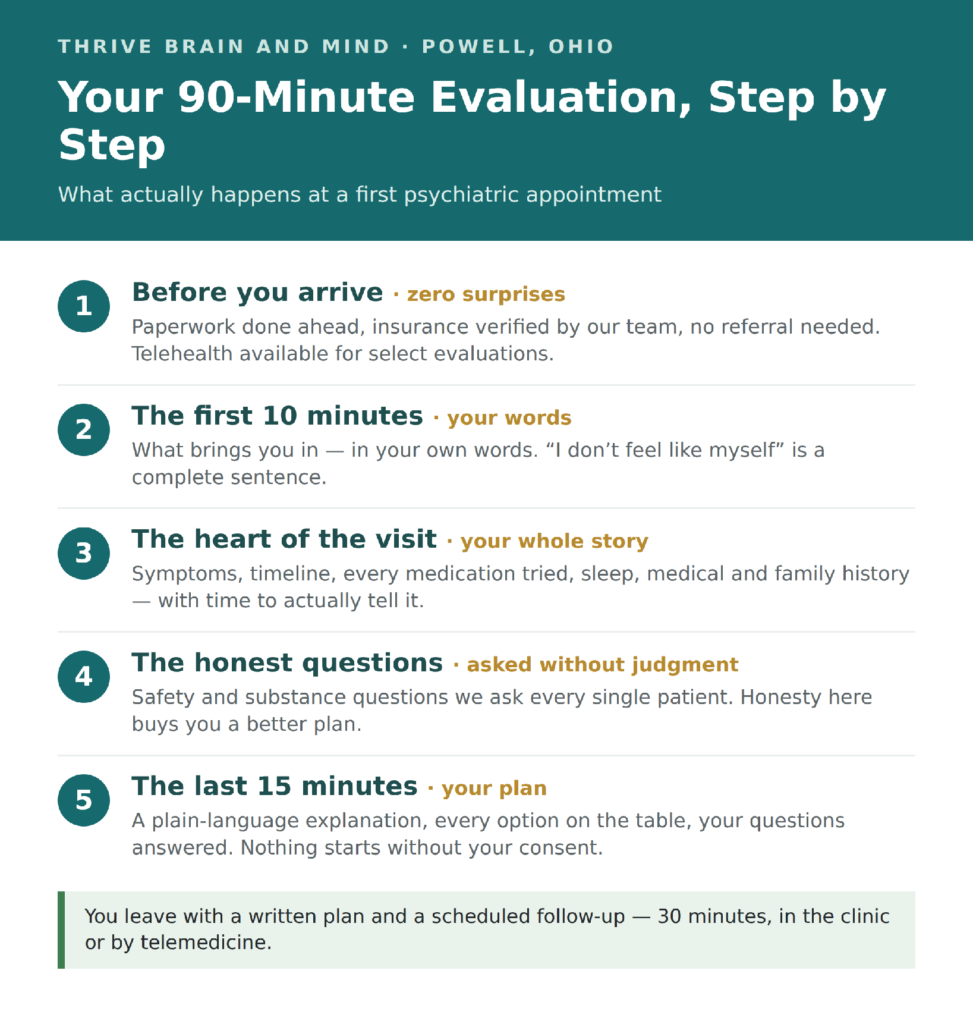
A new-patient evaluation at Thrive Brain and Mind runs about 90 minutes. Not fifteen. Not a form and a handshake. Ninety minutes, because getting the story right the first time is faster than getting it wrong quickly. Here’s how they’re spent.
Before you arrive: zero surprises
The logistics happen before the day itself. Our team verifies your insurance benefits and walks you through any out-of-pocket costs, the intake paperwork is done ahead of time, and you don’t need a referral from anyone — you can simply call. Telehealth is available for select new-patient evaluations if getting to Powell is the obstacle.
The first 10 minutes: your words
We start where you are. What brings you in, in your own words — not a checklist, not an interrogation. Some people arrive with pages of notes. Some arrive with “I don’t know, I just know something’s wrong.” Both are perfect starts. There is no wrong door into this conversation.
The heart of the visit: your whole story
This is where the time goes, and it’s the part a rushed intake can’t do. Your symptoms and their timeline. Every medication you’ve tried, at what dose, for how long, and what happened. Your sleep. Your medical history and your family’s mental health history. School and work. What’s changed and when. Along the way we use short standardized checklists — like the Patient Health Questionnaire-9 (PHQ-9), a well-validated nine-question depression measure [1] — so that from day one, your progress gets measured, not guessed. If you’ve read my post on the five questions I ask every patient, this is where they happen.
The honest questions: asked without judgment
Two sets of questions surprise people. First, safety: I ask every single patient about thoughts of death or suicide, matter-of-factly, because the question saves lives and because you deserve a doctor who isn’t afraid of it. Second, substances: alcohol, cannabis, everything else — asked the way I’d ask about sleep. I’m board-certified in addiction medicine; there is no judgment in this room, only information that makes your plan smarter. Patients who answer these questions honestly get better plans. It’s that direct.
The last 15 minutes: your plan
Then I give the time back to you. What I think is going on, in plain language — including when the picture is still incomplete and what would clarify it. Every reasonable option explained: therapy, medication strategies, and for depression that hasn’t responded to medications, interventional treatments like TMS and Spravato. What I recommend and why. What it costs and what insurance covers. And your questions — all of them. You will not be handed a prescription on your way out the door as a substitute for an explanation.
What you leave with
A plan in writing. A scheduled follow-up — focused 30-minute visits, in the clinic or by telemedicine. And, depending on your plan, connections within our own team: therapists for structured therapy, and child and adolescent psychiatry for younger family members. One practice, one chart, one team that talks to each other.
| Segment | What happens | Why it matters |
|---|---|---|
| Before you arrive | Insurance verified, paperwork done, no referral needed | No surprises on the day |
| First 10 minutes | What brings you in — your words, your pace | There is no wrong door |
| The heart of the visit | Full history: symptoms, timeline, medications, sleep, family — plus the PHQ-9 | Right story → right diagnosis |
| The honest questions | Safety and substance questions, asked of everyone | Honesty buys a better plan |
| The last 15 minutes | Plain-language explanation, every option, your questions | Nothing starts without consent |
| Leaving | Written plan + scheduled 30-minute follow-up (clinic or telemedicine) | You’re never left drifting |
The Results: What a Good Evaluation Changes
Back to Emily. Her 90 minutes turned up something a shorter visit had missed twice: the “anxiety” she came in for was riding on top of undiagnosed attention-deficit/hyperactivity disorder (ADHD) that had been quietly burning her out since college. Different picture, different plan — and within two months, a different Emily. That’s the quiet power of a real evaluation: the diagnosis is half the cure.
And sometimes the result is simpler than a diagnosis. It’s relief. The average person waits close to a decade between first symptoms and first treatment [2] — walking into that room at all means you’ve just beaten one of the worst statistics in medicine. Nearly half of Americans will meet criteria for a mental health condition at some point in their lives. [3] You’re not unusual. You’re just finally in the room.
One more honest note: occasionally an evaluation ends with reassurance — what you’re experiencing is within a normal range, here’s what to watch, come back if it changes. That answer is worth every bit as much as a diagnosis. Either way, you stop guessing.
Who You’ll Meet: One Team, Whole Families — in Powell and Columbus, Ohio
Thrive Brain and Mind is a collaborative, multidisciplinary practice: psychiatrists, child and adolescent psychiatry, and therapists under one roof, caring for children, adolescents, and adults. Your evaluation is with me — Dr. John J. Aziz. I’m a quadruple board-certified psychiatrist: general psychiatry, consultation-liaison (mind-body) psychiatry, addiction medicine, and psychopharmacology. I trained in psychiatry at Vanderbilt University Medical Center, where I also served as chief resident, followed by a fellowship at Duke University — and I’ve spent more than 30 years treating depression, anxiety, ADHD, bipolar disorder, PTSD, OCD, schizophrenia and schizoaffective disorder, substance use disorders, and psychosomatic conditions, where physical symptoms are tangled with mental health.
If the evaluation points toward treatment-resistant depression, the full interventional toolbox — TMS on our Magstim system, Spravato in our REMS-certified center, and ketamine injection therapy — lives in the same building. No referral needed to get started, insurance verified before your first visit, and telehealth available for select evaluations. We serve the greater Columbus area — Dublin, Westerville, Lewis Center, Delaware, and Upper Arlington — from 3785 Attucks Drive in Powell, with a second office in Logan.
→ Schedule your evaluation at Thrive Brain and Mind — call 614-588-8177. No referral needed.
Frequently Asked Questions
How long does a psychiatric evaluation take at Thrive Brain and Mind?
About 90 minutes for a new-patient evaluation — enough time to take your whole story properly. Follow-up visits are focused 30-minute appointments, in the clinic or by telemedicine.
What should I bring to a first psychiatric appointment?
Four things: photo ID, your insurance card, your current medications with doses, and a list of psychiatric medications you’ve tried in the past. It also helps to jot down two or three things you want to be different. No paperwork marathon — intake forms are completed ahead of your visit.
Will I be put on medication at my first appointment?
Not automatically — an evaluation is not a prescription. You’ll leave with a clear explanation and a plan you helped choose. When medication is recommended, it’s explained fully and started only with your consent; therapy or other approaches are often part of the plan as well.
Do I need a referral for a psychiatric evaluation?
No. You can call Thrive Brain and Mind directly at 614-588-8177. Our team verifies your insurance benefits before your first visit, so there are no surprises.
Can my child or teenager be evaluated at Thrive Brain and Mind?
Yes. Thrive Brain and Mind is a multidisciplinary practice caring for children, adolescents, and adults, with child and adolescent psychiatry on the team. Dr. Aziz personally treats adolescents and adults. If you’re unsure whether your child’s changes warrant an evaluation, start with the three questions in our guide for parents.
Can a psychiatric evaluation be done by telehealth near Columbus, Ohio?
Select new-patient evaluations and most follow-ups can be done by telemedicine, depending on your situation. Call 614-588-8177 and our team will help you choose the right format — in person in Powell or Logan, or by video.
This article is for education and is not a substitute for personalized medical advice, diagnosis, or treatment. Every evaluation is individualized — the walkthrough above describes a typical visit, and yours may differ. If you are in crisis, call or text 988 — the Suicide & Crisis Lifeline — available 24/7.
RESOURCES & STUDIES CITED
1. Kroenke K, Spitzer RL, Williams JB. The PHQ-9: validity of a brief depression severity measure. Journal of General Internal Medicine. 2001;16(9):606–613. https://pubmed.ncbi.nlm.nih.gov/11556941/
2. Wang PS, et al. Failure and delay in initial treatment contact after first onset of mental disorders in the National Comorbidity Survey Replication. Archives of General Psychiatry. 2005;62(6):603–613. https://pubmed.ncbi.nlm.nih.gov/15939838/
3. Kessler RC, et al. Lifetime prevalence and age-of-onset distributions of DSM-IV disorders in the National Comorbidity Survey Replication. Archives of General Psychiatry. 2005;62(6):593–602. https://pubmed.ncbi.nlm.nih.gov/15939837/
4. National Institute of Mental Health. Tips for talking with a health care provider about your mental health (patient resource — not cited in text). https://www.nimh.nih.gov/health/publications/tips-for-talking-with-your-health-care-provider