
I wrote my first prescription for depression in 1991, the year I finished medical school at Cairo University. I have been treating it ever since — through psychiatry residency and chief residency at Vanderbilt University Medical Center, a fellowship at Duke, and more than two decades of practice, in hospital wards, consult rooms, nursing homes, and now the office in Powell, Ohio where I see patients today. The tools have changed beyond recognition in that time: from a short shelf of medications to structured therapies, brain stimulation, and nasal sprays that can lift depression in days. The first question patients ask has not changed at all: “Doctor, will I ever feel like myself again?”
I’m writing this because psychiatry is changing in a way that worries me. Mental health care is rapidly becoming an app. A queue. A twelve-minute video call with a prescriber you’ll never see again. Access matters, and I’m glad more people are getting care. But somewhere in the scaling-up, the field risks losing what three decades across the same desk teaches — and patients can feel the difference, which is why so many are searching for an experienced human being they can actually trust.
So here is what the long way taught me. Seven lessons. Every patient detail below is a composite with identifying details changed. Every lesson is exactly as true as I can make it.
“The tools have changed beyond recognition in 30 years. The first question patients ask: “Will I ever feel like myself again?” The honest answer, more than ever, is yes.”
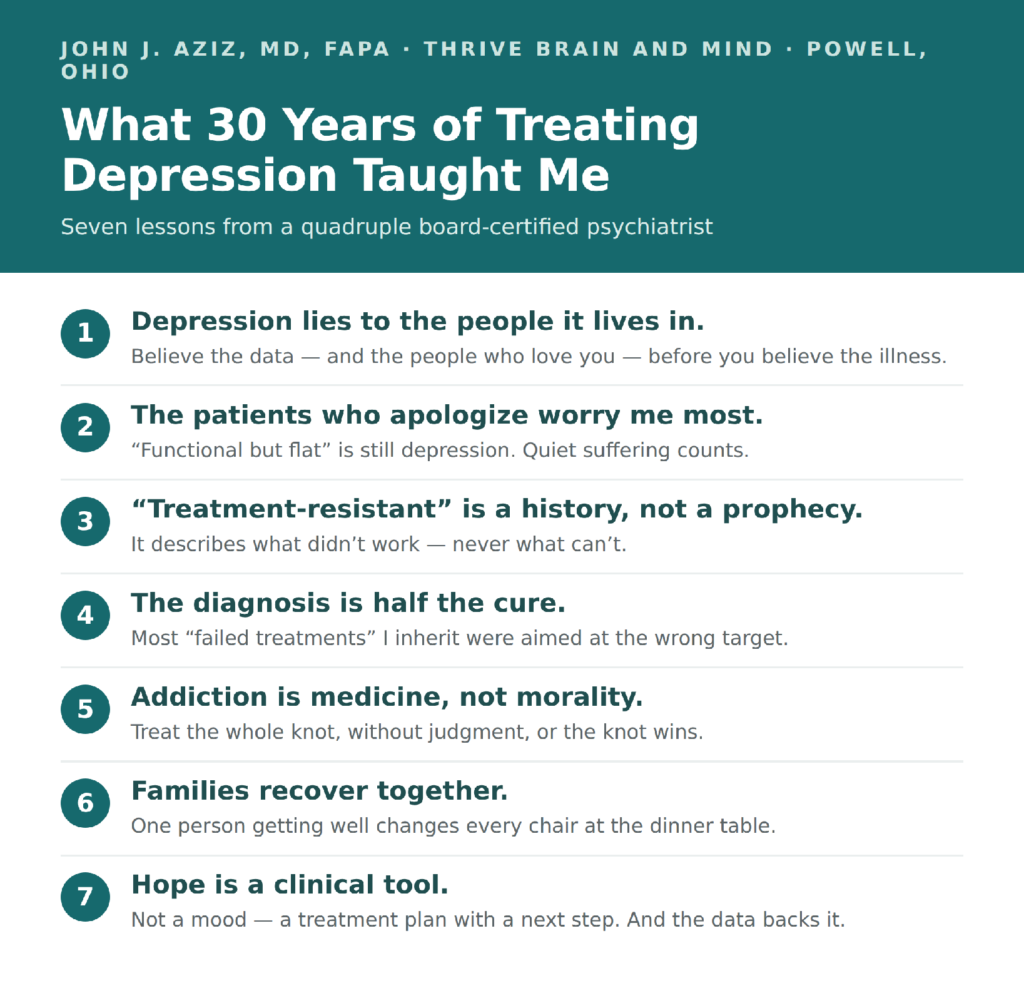
Lesson 1: Depression lies to the people it lives in.
The illness edits its own story. I have watched patients sleep better, return to work, and laugh at my bad jokes — while telling me, sincerely, that nothing is working. Depression narrates your life from inside your own voice, which makes it the most credible liar you will ever meet. This is why I measure: simple symptom scales, tracked at every visit, because the illness can argue with your feelings but it cannot argue with its own numbers. And it’s why I tell families: your observations are clinical data. The most reliable early sign of recovery I know is when the spouse smiles before the patient does.
Lesson 2: The patients who apologize worry me most.
“I’m sorry — you probably have sicker people to see.” After 30 years, that sentence still stops me. The patients in visible crisis get help; the system is built for them. The ones who wait years are the high-functioning apologizers — the project managers and nurses and parents running a household at sixty percent, calling it “fine,” certain they haven’t earned the appointment. Hear me: suffering does not have to be spectacular to deserve treatment. “Functional but flat” is not a personality. It is a treatable condition, and treating it early is far easier than treating it late.
Lesson 3: “Treatment-resistant” is a history, not a prophecy.
The phrase describes what didn’t work — never what can’t. The largest depression study ever run found that with each failed medication, the odds of the next one working fall sharply; yet patients who kept stepping through different, evidence-based approaches reached remission about two-thirds of the time. [1] I did my fellowship training at Duke in electroconvulsive therapy (ECT) — the oldest and most powerful treatment for the most severe depressions — and I have personally watched depressions everyone had given up on reverse. Today my toolbox for stubborn depression is broader and gentler: Transcranial Magnetic Stimulation (TMS), Spravato (esketamine), ketamine. In 30 years, the group of patients I would call truly out of options has shrunk to nearly zero. “Resistant to what we’ve tried” has never once meant “resistant to everything that exists.”
Lesson 4: The diagnosis is half the cure.
Most of the “failed treatments” I inherit were aimed at the wrong target. The “depression” that was actually bipolar disorder, worsening quietly on antidepressants alone. The burned-out adult whose lifelong attention-deficit/hyperactivity disorder (ADHD) had been mislabeled laziness for forty years. The fatigue that was a thyroid, the insomnia that was apnea, the “anxiety” that was a heart rhythm. My training in consultation-liaison psychiatry — the specialty where mind and body share one chart — taught me to re-diagnose before I re-prescribe. It is the least glamorous skill in psychiatry, and the one that changes the most lives.
Lesson 5: Addiction is medicine, not morality.
I am board-certified in addiction medicine, and here is the whole specialty in one sentence: shame hides data, and hidden data kills treatment plans. The nightly six-pack nobody asked about. The cannabis that “doesn’t count.” The pills borrowed from a spouse. When I ask about substances the same way I ask about sleep — flatly, kindly, without the eyebrow — patients tell me the truth, and suddenly the antidepressant that “never worked” has an explanation. Depression and addiction are usually one knot, not two problems. Judge the knot and it tightens. Treat it, together, and it comes loose.
Lesson 6: Families recover together.
Thirty years of watching households taught me that depression is never a solo illness. A mother comes back to life, and six months later her son’s grades recover. A teenager stabilizes, and a marriage exhales. A grandfather finally gets treated at seventy, and three generations learn, at once, that asking for help is a thing our family does now. It’s why our practice is built the way it is — psychiatrists, child and adolescent psychiatry, and therapists in one place, caring for children, adolescents, and adults. Depression rarely lives in just one chair at the dinner table. Neither does recovery.
Lesson 7: Hope is a clinical tool — and I can defend it with data.
I don’t mean optimism; temperament is cheap. I mean hope as a treatment plan with a next step — prescribed as deliberately as any medication. The data behind it: nearly half of us will meet criteria for a mental health condition in our lifetime, [2] so you are not rare — and neither is recovery. Waiting makes depression harder to treat, [3] so the next step matters more than the perfect step. And when patients keep stepping instead of quitting, most get well. [1] In 30 years I have never regretted telling a patient the truth. The truth is better than most patients believe.
If You Were in My Office Tomorrow
Here’s what I would tell you, across the desk, in the first five minutes. You are not weak — you are outnumbered, and that’s different. Don’t wait for the “right time”; the illness will always vote for later. And bring the messy version of your story, not the tidy one — the mess is where the medicine is. If the first appointment itself is what you’re dreading, I’ve written down exactly what happens in it, minute by minute, so there are no unknowns left to fear.
Thirty years in, the best part of this job has never changed: the visit where someone gets their “want to” back. If your antidepressant has stopped working, if your teenager has gone quiet, if you have been “functional but flat” long enough — come. Bring the mess. We know what to do with it.
And if you are having thoughts of suicide tonight, don’t wait for any office: call or text 988, the Suicide & Crisis Lifeline, right now, or go to the nearest emergency room.
→ Schedule an evaluation at Thrive Brain and Mind — call 614-588-8177. No referral needed.
John J. Aziz, MD, FAPA — Fellow of the American Psychiatric Association (FAPA) — is a quadruple board-certified psychiatrist: general psychiatry, consultation-liaison (mind-body) psychiatry, addiction medicine, and psychopharmacology. He earned his medical degree from Cairo University School of Medicine (1991), completed his psychiatry residency and chief residency at Vanderbilt University Medical Center, and completed fellowship training at Duke University. With more than 30 years of clinical experience, he treats adolescents and adults at Thrive Brain and Mind in Powell, Ohio — a collaborative, multidisciplinary practice whose team, including child and adolescent psychiatry and therapists, cares for children, adolescents, and adults across the greater Columbus area. His clinical focus includes depression, anxiety, ADHD, bipolar disorder, PTSD, and OCD, with a special interest in treating severe depression with TMS, Spravato, and ketamine injection therapy.
Frequently Asked Questions
Is Dr. John Aziz accepting new patients?
Yes. Dr. Aziz personally treats adolescents and adults at Thrive Brain and Mind in Powell, Ohio, and the practice’s multidisciplinary team — including child and adolescent psychiatry — cares for children as well. In most cases, no referral is needed; call 614-588-8177 and the team verifies your insurance before your first visit.
What conditions does Dr. John Aziz treat?
Depression and bipolar disorder, anxiety disorders, ADHD, PTSD, OCD, schizophrenia and schizoaffective disorder, substance use disorders, and psychosomatic conditions where physical symptoms are linked to mental health — with a special interest in severe and treatment-resistant depression treated with TMS, Spravato, and ketamine injection therapy.
Where does Dr. John Aziz practice?
At Thrive Brain and Mind: 3785 Attucks Drive, Powell, Ohio (serving the greater Columbus area), with a second office in Logan, Ohio. Telehealth is available for select evaluations and most follow-up visits.
This essay is for education and is not a substitute for personalized medical advice, diagnosis, or treatment. Patient details are composites with identifying information changed. Individual results vary. If you are in crisis, call or text 988 — the Suicide & Crisis Lifeline — available 24/7.
RESOURCES & STUDIES CITED
1. Rush AJ, et al. Acute and longer-term outcomes in depressed outpatients requiring one or several treatment steps: a STAR*D report. American Journal of Psychiatry. 2006;163(11):1905–1917. https://psychiatryonline.org/doi/10.1176/ajp.2006.163.11.1905
2. Kessler RC, et al. Lifetime prevalence and age-of-onset distributions of DSM-IV disorders in the National Comorbidity Survey Replication. Archives of General Psychiatry. 2005;62(6):593–602. https://pubmed.ncbi.nlm.nih.gov/15939837/
3. Ghio L, et al. Duration of untreated illness and outcomes in unipolar depression: a systematic review and meta-analysis. Journal of Affective Disorders. 2014;152–154:45–51. https://pubmed.ncbi.nlm.nih.gov/24183486/