
If you’ve been searching for answers, you’ve probably noticed something: almost everything written about medical marijuana cards in Ohio is written by dispensaries or online card mills. The information isn’t necessarily wrong. But it is incomplete — and it’s rarely written by someone whose job is your overall mental and physical health rather than a transaction.
I’m a psychiatrist. I’ve spent 30 years treating conditions like PTSD, chronic pain-related depression, anxiety, and insomnia. I hold an active Certificate to Recommend medical marijuana in Ohio, and I certify patients at Thrive Brain and Mind in Powell.
So this guide is different. I’ll walk you through exactly how to get your Ohio medical marijuana card — the qualifying conditions, the real costs, the step-by-step process — and I’ll also tell you the things a dispensary blog won’t: when a medical card genuinely makes sense (and when it doesn’t), why anxiety and depression alone do not qualify in Ohio — and what to do instead, the honest risks of cannabis for certain patients, especially in psychiatry, and how to make sure cannabis fits into your overall treatment plan instead of replacing it.
“My job isn’t to sell you a card. My job is to make sure the treatment you’re pursuing is actually the right one for your brain and your life.”
First, the Honest Question: Recreational Marijuana Is Legal in Ohio. Do You Still Need a Medical Card?
Ohio voters legalized adult-use (recreational) marijuana in November 2023, and dispensary sales began in August 2024. So a fair question is: “Why would I bother getting a medical card at all?” It’s a good question — and the answer changed significantly in 2026.
In March 2026, Senate Bill 56 took effect and reshaped Ohio’s cannabis laws. Recreational consumers now face tighter rules, new restrictions, and fewer legal protections than before. Medical patients, by contrast, kept — and in several areas strengthened — their advantages. Here’s the current landscape at a glance:
| Feature | Medical Card Holder | Recreational (21+) |
|---|---|---|
| Minimum Age | 18+ (minors with caregiver) | 21+ |
| 10% Excise Tax | Exempt — significant savings for regular purchases | Applies to every purchase |
| Purchase Limits | Higher daily limits | Lower daily limits |
| Product Access | Higher-potency medical products (e.g., stronger edible dosing) | Capped potency on several product categories |
| Dispensary Priority | Legally prioritized during shortages | No priority |
| Home Delivery | Medical patients only (rules being finalized) | Not available |
| Physician Oversight | Annual evaluation; documented medical rationale | None |
| Legal Standing | Registered patient status; strongest position under SB 56 | Reduced protections after SB 56 |
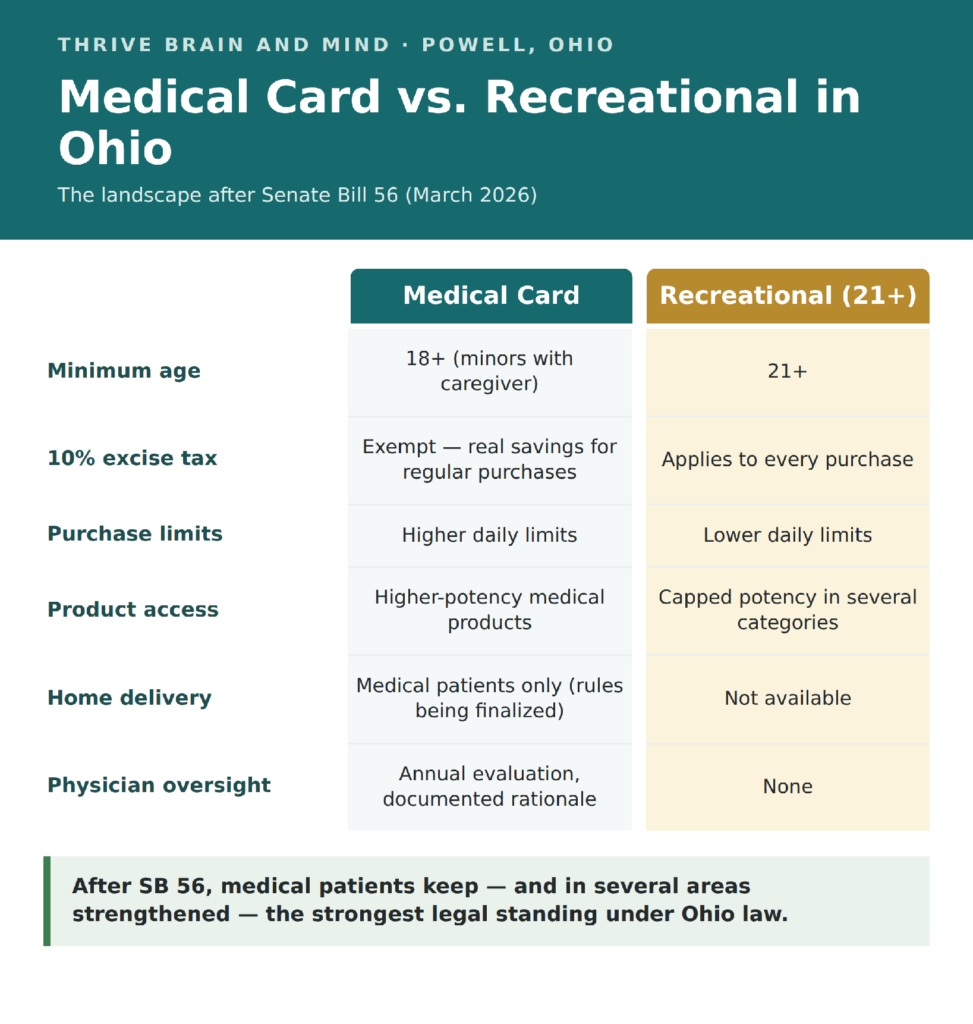
For anyone using cannabis regularly for a medical reason, the tax exemption alone typically pays for the cost of certification within a few months. But in my view, the most underrated benefit isn’t financial: it’s having a physician in the loop. Cannabis interacts with psychiatric medications. It affects sleep architecture, anxiety, motivation, and — in vulnerable individuals — psychosis risk. Using it for a medical condition without any medical oversight is how patients end up treating one problem while quietly creating another.
Who Qualifies: Ohio’s Qualifying Conditions
Ohio law is specific. A physician cannot certify you simply because they believe cannabis would help. You must have at least one diagnosed condition from the state’s approved list. Ohio currently recognizes qualifying conditions including:
| Category | Qualifying Conditions (selected) |
|---|---|
| Pain & Neurological | Chronic and severe or intractable pain; fibromyalgia; spasticity; epilepsy or seizure disorders; Parkinson’s disease; multiple sclerosis; Huntington’s disease; traumatic brain injury; spinal cord disease or injury; chronic migraines, arthritis, and CRPS (recognized under chronic pain) |
| Psychiatric | Post-traumatic stress disorder (PTSD) |
| Cancer & Terminal | Cancer; terminal illness; cachexia (wasting syndrome) |
| Gastrointestinal | Crohn’s disease; inflammatory bowel disease; ulcerative colitis |
| Other Medical | HIV/AIDS; ALS; Alzheimer’s disease; glaucoma; hepatitis C; sickle cell anemia; Tourette syndrome |
What a psychiatrist wants you to notice about this list
Anxiety and depression are not qualifying conditions in Ohio. The State Medical Board has reviewed petitions to add them and declined, citing insufficient evidence and concerns that cannabis can worsen both conditions over time.
I bring this up because a large percentage of the people searching for a medical card are actually struggling with anxiety, depression, or insomnia. If that’s you, two things are true: you may still qualify — many patients with anxiety or depression also have a qualifying condition such as chronic pain or PTSD that has never been formally evaluated or documented. And you may be better served by a different treatment entirely — anxiety and depression are highly treatable, and the evidence-based options, from therapy and medication to interventional treatments like TMS, significantly outperform cannabis for those conditions.
This is exactly why getting certified by a psychiatrist, rather than a five-minute online card mill, works in your favor. The evaluation itself has value: it either documents your qualifying condition properly, or it uncovers what’s actually driving your symptoms.
“Roughly half the patients who come in asking about a marijuana card leave with something more valuable: an accurate diagnosis. Some get the card too. But nobody leaves with just a transaction.”
What if your condition isn’t on the list?
Ohio accepts petitions to add new qualifying conditions during an annual window (November 1 – December 31). More practically: a comprehensive psychiatric evaluation can determine whether you have an existing qualifying condition that was never properly documented — chronic pain being the most common example — or whether another treatment path fits your situation better.
How to Get Your Ohio Medical Marijuana Card: Step by Step
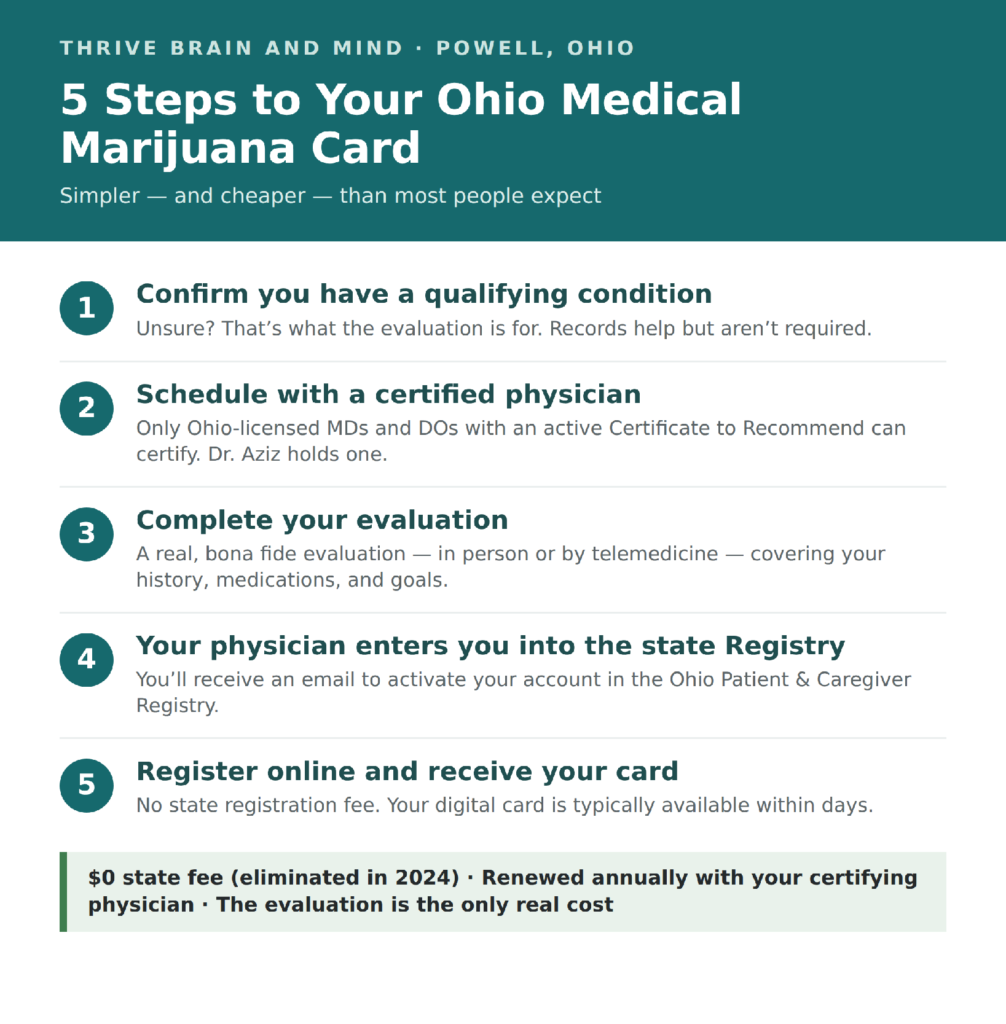
The process is simpler — and cheaper — than most people expect. Ohio eliminated the state registration fee in 2024, so the physician evaluation is now essentially the only cost.
- 1. Confirm you have a qualifying condition. Review the list above. If you’re unsure, that’s what the evaluation is for — bring any medical records, imaging, or prior diagnoses you have. Records aren’t required, but they speed things up considerably.
- 2. Schedule an appointment with a certified physician. Only Ohio-licensed MDs and DOs holding an active Certificate to Recommend (CTR) from the State Medical Board can certify patients. Dr. John J. Aziz holds an active CTR and evaluates patients at Thrive Brain and Mind in Powell.
- 3. Complete your evaluation. Ohio requires a bona fide physician-patient relationship — a real evaluation, in person or via telemedicine. At Thrive Brain and Mind, this includes your full history: the qualifying condition, current medications, mental health screening, and treatment goals.
- 4. Your physician enters your certification into the state Registry. Once certified, your profile is created in the Ohio Medical Marijuana Patient & Caregiver Registry and you receive an email to activate your account.
- 5. Complete your registration online and receive your card. Log in, verify your information, and submit. There is no state registration fee. Your digital card is typically available within days, and you can begin purchasing at any licensed Ohio dispensary.
Your certification must be renewed annually with at least one visit to your certifying physician — which, again, is a feature rather than a bug. An annual check-in is how dosing problems, interactions, and changing symptoms get caught early.
What it actually costs
| Item | Cost | Notes |
|---|---|---|
| State registration fee | $0 | Eliminated by the Division of Cannabis Control in 2024 (previously $50/year) |
| Physician evaluation | Varies by practice | The only real cost; not covered by insurance |
| Annual renewal (state) | $0 | Requires an annual visit with your certifying physician |
| Insurance coverage | None | Federal status means no insurer covers cannabis itself or certification visits |
Why Get Certified by a Psychiatrist Instead of an Online Card Mill?
You can get a certification in ten minutes online for less than the cost of a dinner. So let me be direct about why I think that’s usually a mistake — especially if any part of your reason for seeking cannabis involves sleep, stress, mood, trauma, or focus.
- Cannabis is psychoactive. Whatever condition it’s certified for, it acts on your brain. A clinician who evaluates brains for a living should be the one deciding whether that’s wise for yours.
- Medication interactions are real. Cannabis can interact with antidepressants, mood stabilizers, benzodiazepines, stimulants, and blood thinners. A card mill doesn’t review your medication list. We do.
- Underlying conditions get missed. Chronic pain with depression. PTSD with panic attacks. Insomnia masking untreated ADHD or anxiety. Certify the symptom without evaluating the person, and the real condition stays untreated for years.
- You get an actual treatment plan. For appropriate patients, cannabis can be one tool — alongside therapy, medication, lifestyle changes, and, where needed, interventional options. A plan beats a product.
“The question is never just “Do you qualify?” The question is “Is this the right treatment for you — and what should sit alongside it?””
A Psychiatrist’s Honest Cautions About Cannabis
If this section reads differently from everything else you’ve found online, that’s the point. These are the conversations I have with real patients, and you deserve to hear them before you’re a patient:
- Cannabis and anxiety have a complicated relationship. Low doses can feel calming; higher doses and higher-THC products frequently make anxiety worse, and regular use can increase baseline anxiety between uses. This is one reason Ohio has declined to add anxiety as a qualifying condition.
- Psychosis risk is not theoretical. For people with a personal or family history of psychosis, bipolar disorder, or schizophrenia, high-potency THC meaningfully raises risk. This is a hard stop in my evaluations.
- Young brains are more vulnerable. Brain development continues into the mid-20s. For adolescents and young adults, the risk calculus is different, and the threshold for recommending cannabis should be much higher.
- Cannabis use disorder exists. Roughly one in ten adult users develops problematic use — higher with daily use and high-potency products. Part of responsible certification is screening for that risk honestly and monitoring it over time.
- A card is not legal armor. Ohio employers can still enforce drug-free workplace policies, driving under the influence remains illegal, and cannabis remains federally illegal — which matters for federal employees, CDL holders, and firearm purchasers. Anyone who tells you otherwise is selling something.
None of this means cannabis is bad medicine. For the right patient with the right condition — PTSD with nightmares that haven’t responded to standard treatment, chronic pain that’s led to escalating opioid use, chemotherapy-related nausea — it can be genuinely life-improving. It means cannabis is real medicine, and real medicine deserves real medical judgment.
“I’ve certified patients whose lives clearly improved with cannabis. I’ve also declined to certify patients I believed it would harm. Both are what a physician is for.”
What to Expect at Your Evaluation at Thrive Brain and Mind
Whether you come in specifically for a medical marijuana certification or as part of a broader consultation, the evaluation is thorough and judgment-free:
- A full review of your medical and psychiatric history
- Documentation and verification of your qualifying condition
- A review of every medication and supplement you take
- Screening for conditions that change the risk equation (mood, psychosis risk, substance use history)
- An honest recommendation — certification when appropriate, and a better alternative when it’s not
- Registry entry handled for you, with clear instructions to complete your card
And if the evaluation reveals that what’s actually driving your symptoms is depression, anxiety, PTSD, or ADHD, you’re already sitting in front of a practice built to treat exactly that — including medication management, therapy referral, and interventional options like TMS and Spravato® for treatment-resistant cases.
That’s the difference between a card mill and a psychiatric practice: either way, you leave with answers.
Medical Marijuana Certification in Powell and Columbus, Ohio
Thrive Brain and Mind provides medical marijuana evaluations and certifications at our Powell, Ohio clinic, led by Dr. John J. Aziz, a quadruple board-certified psychiatrist with over 30 years of clinical experience and an active Ohio Certificate to Recommend. Serving patients throughout Powell, Columbus, Dublin, Lewis Center, Delaware, Westerville, Upper Arlington, and surrounding Central Ohio communities.
→ Schedule a medical marijuana evaluation at Thrive Brain and Mind — call 614-588-8177.
Frequently Asked Questions
How much does it cost to get a medical marijuana card in Ohio?
Ohio eliminated the state registration fee in 2024, so registration and annual renewal through the state Registry are free. The only cost is the physician evaluation, which varies by practice and is not covered by insurance. For regular purchasers, the medical program’s exemption from the 10% recreational excise tax typically offsets the evaluation cost quickly.
Can I get an Ohio medical marijuana card for anxiety or depression?
No. Anxiety and depression are not qualifying conditions in Ohio, and the State Medical Board has declined petitions to add them. However, many patients with anxiety or depression also have a qualifying condition — such as chronic pain or PTSD — that has never been formally evaluated. A comprehensive psychiatric evaluation can determine whether you qualify, and if not, identify evidence-based treatments that work better for anxiety and depression than cannabis does.
Does insurance cover a medical marijuana card or cannabis in Ohio?
No. Because marijuana remains federally illegal, insurance does not cover the certification visit or cannabis products. The evaluation is self-pay, and dispensary purchases are out of pocket for all patients.
How long does it take to get a medical marijuana card in Ohio?
Usually days, not weeks. After your evaluation, your physician enters your certification into the Ohio Medical Marijuana Patient & Caregiver Registry, you complete your registration online, and your digital card is typically available shortly after — often within one to two business days.
Is a medical card still worth it now that recreational marijuana is legal in Ohio?
For medical users, usually yes. Medical cardholders are exempt from the 10% excise tax, have higher purchase limits, can access higher-potency medical products, receive priority at dispensaries during shortages, are eligible for home delivery as rules are finalized, and qualify at 18 rather than 21. After Senate Bill 56 took effect in March 2026, medical patients also retain the strongest legal standing under Ohio law. Most importantly, the medical pathway includes physician oversight.
Can I do my medical marijuana evaluation by telemedicine?
Ohio allows the required physician visit to occur in person or via telemedicine, provided a bona fide physician-patient relationship is established. Contact our office to discuss which option fits your situation.
Will getting a medical marijuana card affect my job?
It can. Ohio employers may still enforce drug-free workplace policies and are not required to accommodate medical marijuana use. If you work in a safety-sensitive role, hold a CDL, or are a federal employee, discuss this openly during your evaluation — it’s part of an honest risk-benefit conversation.
This article is for education and is not legal or medical advice. Cannabis affects individuals differently; certification decisions are made only through a bona fide physician evaluation. Marijuana remains illegal under federal law. If you are in crisis, call or text 988 — the Suicide & Crisis Lifeline — available 24/7.