
It’s late, and you have three tabs open — three psychiatry websites, all listing the same services. Medication management. TMS. Spravato. Ketamine. Every site sounds confident. And none of them answers the question you’re actually asking: how would you decide what I need? Fair question. Let me show you. Not the menu — the thinking.
Start with two patients who sat in my office in the same week last spring. Both said the identical sentence: “The medication isn’t working.” One left with a plan built around better medication — a different dose, a different pairing, a therapy referral. The other left with a plan that moved beyond pills entirely, toward Transcranial Magnetic Stimulation (TMS). Same sentence. Two opposite answers. And both patients got well.
I’ll call them Maria and Tom (details changed to protect privacy). Maria, 35, a graphic designer: one antidepressant, prescribed two years ago, never adjusted since, “sort of helps.” Tom, 48, a warehouse supervisor: four medications over six years, each one a fresh disappointment, plus a folder of printouts about ketamine he was half-embarrassed to hand me. Keep them both in mind. The five questions below are the exact ones I ran them through.
“A practice that offers only one treatment will always believe you need that treatment. The cure for that bias is a full toolbox — and a framework for choosing from it honestly.”
Your Task: Ask the Right Question
Most people arrive asking, “Which treatment is best?” That question has no answer — there is no best, any more than there’s a best tool in a toolbox. The right question is: “Which treatment is right for me, right now, given my history?” Here’s how to hold that question well:
- Don’t self-prescribe from the internet. Arriving convinced you need ketamine — like Tom — or convinced you could never do a “brain treatment” closes doors before the evidence opens them. Bring your story, not your conclusion.
- Do bring your full history. Every medication you’ve tried, at what dose, for how long, and what happened. This single list does more to determine your path than anything else you can carry through our door.
- Don’t pick a practice that can only give one answer. If a clinic offers nothing but medication refills, or nothing but one device, guess what the recommendation will be. Ask any practice you’re comparing: what else do you offer, and how do you decide?
And before any framework: if you are having thoughts of suicide, the decision tree collapses to one branch. Call or text 988, the Suicide & Crisis Lifeline, right now, or go to the nearest emergency room.
The Framework: The Five Questions I Ask Every Patient
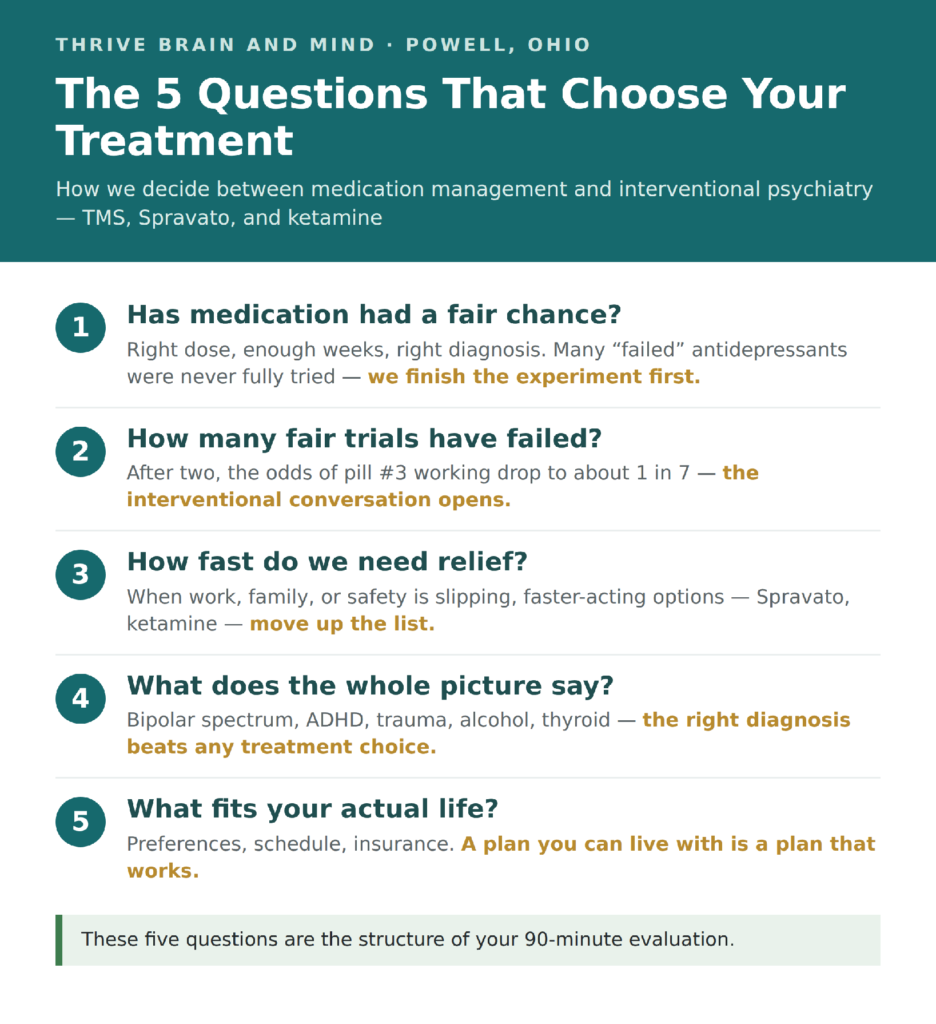
This is the actual clinical reasoning — the same sequence I run in the room, in order, during your 90-minute evaluation.
Question 1: Has medication had a fair chance?
You’d be surprised how often the answer is no. A “failed” antidepressant that was never raised past the starting dose isn’t a failure — it’s an incomplete experiment. Same for a medication taken for three weeks, or taken alongside nightly alcohol, or prescribed for the wrong diagnosis. This was Maria’s story: one medication, one dose, two years, zero adjustments. Her treatment hadn’t failed. It had never fully been tried.
- The bottom line. If medication never got a fair shot, we give it one — done properly this time — before anything fancier.
Question 2: How many fair trials have failed?
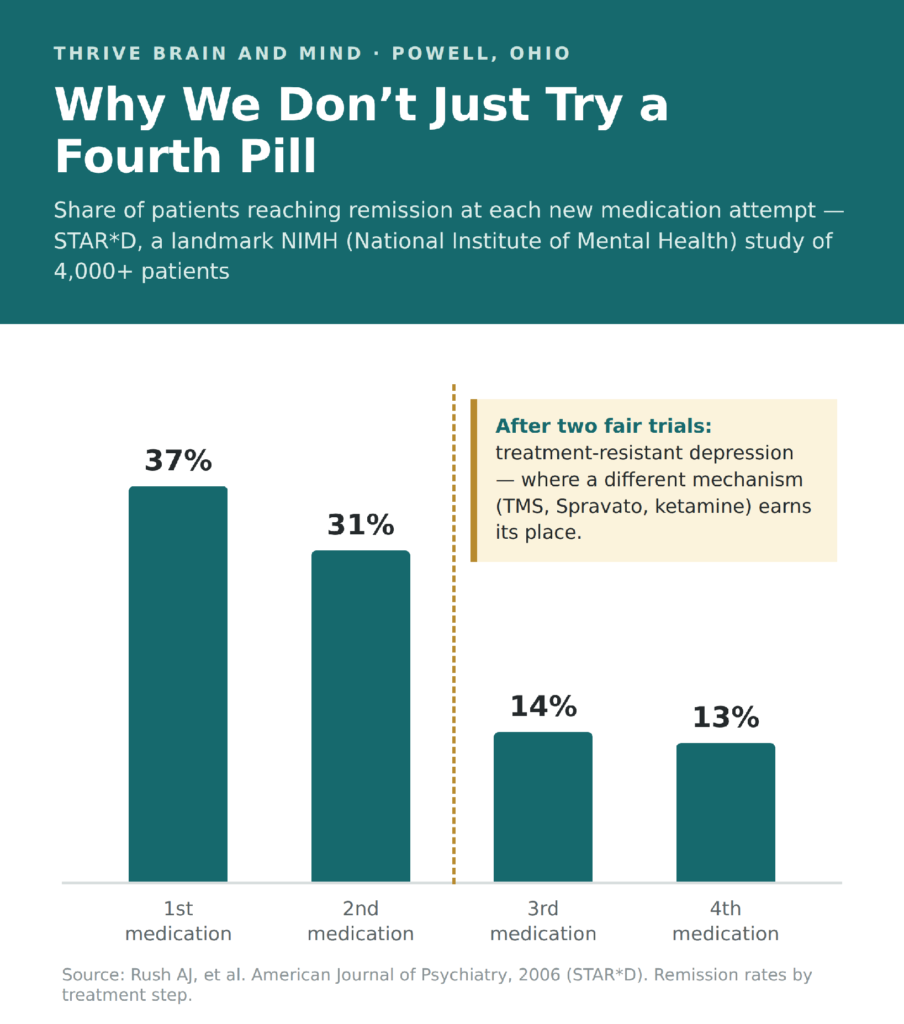
The math changes as trials fail. In the largest depression study ever run, about one in three people got fully well on their first antidepressant. One in four got well on the second. By the third and fourth, the odds dropped to roughly one in seven. [1] Two or more fair trials without recovery is the working definition of treatment-resistant depression (TRD). Roughly 30 percent of treated adults reach that stage. [2] That was Tom: four medications, six years. His next step was never going to be a fifth prescription.
- The bottom line. Two or more fair failures ends the “just try another pill” era. The interventional conversation opens.
Question 3: How fast do we need relief?
Depression has different speeds, and so do treatments. If someone is barely holding their job, their marriage, or their safety, a treatment that takes six weeks to show up may be six weeks too slow. Urgency tips the scale toward the faster-acting options. With Spravato (esketamine) — approved by the U.S. Food and Drug Administration (FDA) — roughly seven in ten patients responded within four weeks in the pivotal trial, some in the first one to two weeks. [3] And in a landmark National Institute of Mental Health (NIMH) trial, many patients improved within 24 hours of a single ketamine dose. [4] When the house is on fire, we reach for the fast water.
- The bottom line. The more function and safety are slipping, the higher the fast options move on the list.
Question 4: What does the whole picture say?
Sometimes “the medication isn’t working” really means “we’ve been treating the wrong thing.” Unrecognized bipolar disorder. Attention-deficit/hyperactivity disorder (ADHD) quietly sabotaging everything. Old trauma. Thyroid disease. Alcohol doing nightly demolition work. This question is where my board certifications earn their keep — the whole picture decides whether we need a different treatment or a different diagnosis.
- The bottom line. Diagnosis first, treatment second — always in that order. Nothing on our menu can outperform a wrong diagnosis.
Question 5: What fits your actual life?
Medicine that ignores your life doesn’t get taken. Some patients want no more daily medication in their bodies — TMS, with no systemic medication and no downtime, honors that. Some can’t do twice-weekly monitored visits — that matters for Spravato scheduling. Some need insurance to carry the cost; some value the fastest option regardless. Your values and logistics don’t override the medicine, but they absolutely shape the recommendation.
- The bottom line. The best plan on paper loses to the plan you’ll actually live. Your life gets a vote.
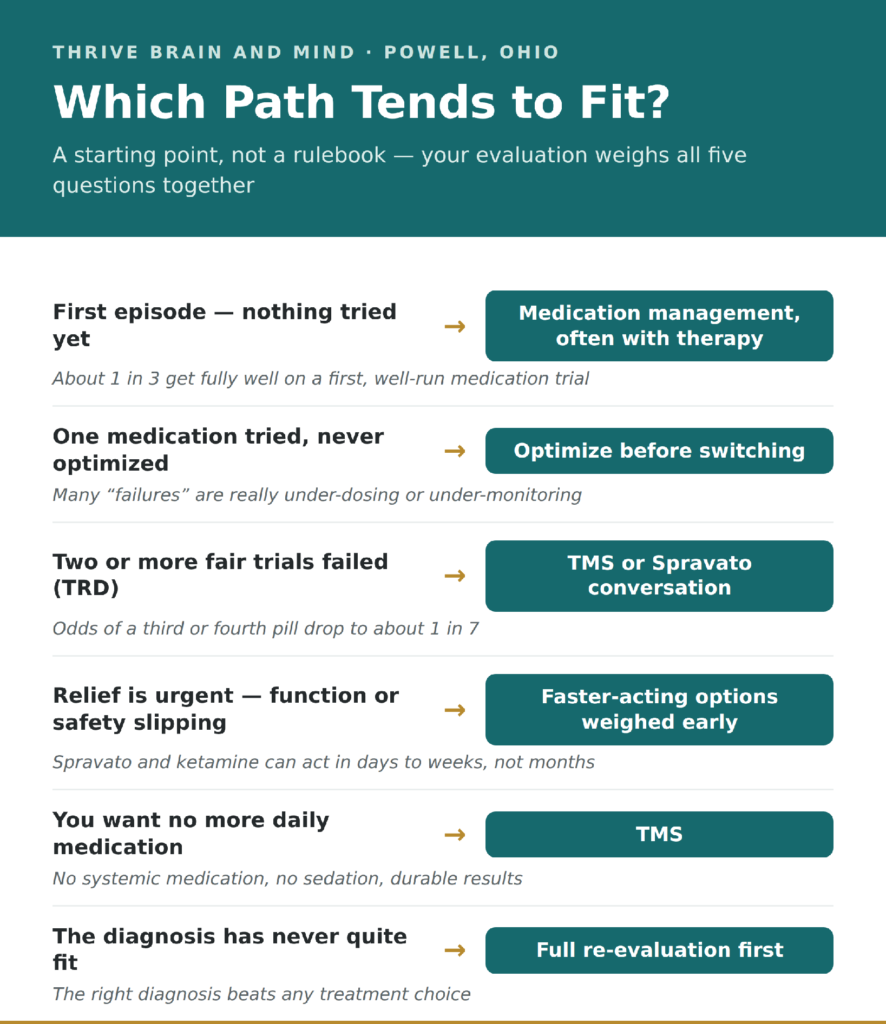
| Your situation | Where we usually start | Why |
|---|---|---|
| First episode, no medication tried yet | Medication management, often with therapy | About 1 in 3 get fully well on a first, well-run trial |
| One medication tried, never optimized | Optimize before switching | Many “failures” are really under-dosing or under-monitoring |
| Two or more fair trials failed (TRD) | Interventional conversation: TMS or Spravato | Odds of a third or fourth pill drop to about 1 in 7 |
| Relief is urgent — function or safety slipping | Faster-acting options weighed early | Spravato and ketamine can act in days to weeks, not months |
| You want no more daily medication | TMS | No systemic medication, no sedation, durable results |
| Diagnosis has never quite fit | Full re-evaluation first | The right diagnosis beats any treatment choice |
A starting point, not a rulebook — the five questions interact, and your evaluation is where they get weighed together.
What Each Path Looks Like at Thrive Brain and Mind
Medication management here is not a refill mill. It starts with that 90-minute evaluation, then focused 30-minute follow-ups — in the clinic or by telemedicine — where we adjust by the numbers: your symptoms tracked with the Patient Health Questionnaire-9 (PHQ-9) at every visit, doses titrated deliberately, side effects taken seriously, therapy paired in when it multiplies the odds. Done this way, medication remains one of the most effective tools in psychiatry — it just has to actually be done this way.
Interventional psychiatry is the menu beyond the daily pill, for depression that has outlasted it. TMS uses focused magnetic pulses — on our Magstim system — with no medication and zero downtime. In a large real-world study, 58 percent of patients responded and 37 percent reached full remission, [5] and about two out of three responders were still well a year later. [6] Spravato is an esketamine nasal spray, taken under supervision in our office — we are a Risk Evaluation and Mitigation Strategy (REMS)-certified center. Since the FDA’s 2025 update, it can be used for TRD on its own or alongside an oral antidepressant. [7] And ketamine injection therapy is off-label, typically self-pay, and the fastest-acting option we offer. I’ve written full deep-dives on each. The point here: they all live in one building, under one clinical brain.
And hear this clearly: these paths are not either/or. Tom stayed on his most-helpful medication while TMS did its work — that’s standard practice. Spravato pairs with an oral antidepressant or stands alone, depending on your diagnosis. The five questions don’t just pick a lane; they often build a combination.
“We don’t marry a treatment. We marry your recovery — and we’ll change tools as many times as your recovery requires.”
The Results: Same Sentence, Two Recoveries
Maria never needed anything interventional. We raised her dose properly, moved it to morning, added eight weeks of structured therapy, and tracked her PHQ-9 from 16 down to 4. Total cost of the fix: two medication adjustments and some patience. “Two years,” she said at her last 30-minute telemedicine follow-up, “and it was a dose change.” It usually isn’t that simple — but sometimes it truly is, and Question 1 exists so we never miss the simple answer.
Tom’s road was longer, as his history predicted. TMS, five days a week, while staying on his medication. Quiet until week four — I’d told him his clock might run slow, and everyone’s does run differently — then the turn: sleeping through the night, back in his bowling league, PHQ-9 from 21 to 7 by the end of the course. A year later he’s still well, on maintenance check-ins and one medication instead of a drawerful. His folder of ketamine printouts turned out to be the wrong guess but the right instinct: he was correct that pills alone weren’t his answer. The framework just found a better door than the one he’d picked.
Zoom out, and the lesson is bigger than either story. In that same landmark study, patients who kept moving through evidence-based steps — instead of repeating the one that failed — reached remission about two-thirds of the time. [1] The framework is how you keep moving without guessing. Your timeline will be your own. The same variables that shape every recovery apply here: how long the episode has run, what came before, sleep, alcohol, other conditions, life stress. What the framework guarantees isn’t a date. It’s that you will never be parked on a failing plan.
One Practice, Every Option — in Powell and Columbus, Ohio
- The full menu under one roof. Medication management, therapy, Magstim TMS, REMS-certified Spravato, and ketamine injection therapy — so the recommendation follows the evidence, not the equipment list.
- A framework, not a sales script. The five questions above are the actual structure of your 90-minute evaluation with me — Dr. John J. Aziz, quadruple board-certified, 30-plus years, including addiction medicine for the tangled cases.
- Measured, not guessed. PHQ-9 tracking at every visit, formal review points on every path, and a standing rule: no one gets strung along.
- Every age, every stage. Children, adolescents, and adults — including TMS for adolescents 15 and older as an add-on treatment.
- No referral needed. Call directly. Our team verifies your insurance before your first visit, and telehealth is available for select evaluations and follow-ups.
We serve the greater Columbus area — Dublin, Westerville, Lewis Center, Delaware, and Upper Arlington — from our clinic at 3785 Attucks Drive in Powell, Ohio, with a second office in Logan. If you’ve been comparing practices tonight, bring us the hard version of your story. The five questions are waiting.
→ Schedule an evaluation at Thrive Brain and Mind — call 614-588-8177. No referral needed. CTA
Frequently Asked Questions
What is interventional psychiatry?
Interventional psychiatry covers office-based treatments that work beyond the daily oral medication — at Thrive Brain and Mind, that means Transcranial Magnetic Stimulation (TMS), Spravato (esketamine) nasal spray, and ketamine injection therapy. These treatments use different biological mechanisms than standard antidepressants and are used mainly for depression that hasn’t responded to medication.
What does medication management actually involve?
Far more than refills. At Thrive Brain and Mind it starts with a 90-minute evaluation, then focused 30-minute follow-ups in the clinic or by telemedicine — with symptoms tracked at every visit using the PHQ-9, doses adjusted deliberately, side effects addressed, and therapy paired in when it improves the odds.
How do you decide whether I need medication or an interventional treatment?
Five questions, in order: Has medication had a fair chance? How many fair trials have failed? How fast do we need relief? What does your whole picture — diagnosis, other conditions, substances — say? And what fits your actual life? The answers usually point clearly to a starting path, and formal review points keep the plan honest.
Can I do medication and interventional treatments at the same time?
Often, yes. TMS is commonly added while you stay on your current medication, and Spravato is used for treatment-resistant depression either on its own or alongside an oral antidepressant under the FDA’s 2025 update. Combinations are decided at your evaluation, not by default.
Do I have to fail medications before trying TMS or Spravato?
Generally, yes — both clinically and for insurance. TMS and Spravato are indicated for depression that hasn’t responded to antidepressant treatment, and most insurance plans require documented medication trials, which most candidates already have. Our team verifies your specific coverage before anything begins.
Where can I find interventional psychiatry near Columbus, Ohio?
Thrive Brain and Mind offers the full range — medication management, therapy, Magstim TMS, REMS-certified Spravato treatment, and ketamine injection therapy — at our Powell, Ohio clinic serving the greater Columbus area, with a second office in Logan. We see children, adolescents, and adults, no referral needed. Call 614-588-8177 to schedule an evaluation with Dr. John J. Aziz.
This article is for education and is not a substitute for personalized medical advice, diagnosis, or treatment. Individual situations, results, and timelines vary — the framework above describes how treatment decisions are approached, not a guarantee of any outcome. Never start or stop a prescription medication without talking to your prescriber. If you are in crisis, call or text 988 — the Suicide & Crisis Lifeline — available 24/7.
RESOURCES & STUDIES CITED
1. Rush AJ, et al. Acute and longer-term outcomes in depressed outpatients requiring one or several treatment steps: a STAR*D report. American Journal of Psychiatry. 2006;163(11):1905–1917. https://psychiatryonline.org/doi/10.1176/ajp.2006.163.11.1905
2. Zhdanava M, et al. The prevalence and national burden of treatment-resistant depression and major depressive disorder in the United States. Journal of Clinical Psychiatry. 2021;82(2):20m13699. https://pubmed.ncbi.nlm.nih.gov/33989464/
3. Popova V, et al. Efficacy and safety of flexibly dosed esketamine nasal spray combined with a newly initiated oral antidepressant in treatment-resistant depression (TRANSFORM-2). American Journal of Psychiatry. 2019;176(6):428–438. https://pubmed.ncbi.nlm.nih.gov/31109201/
4. Zarate CA Jr, et al. A randomized trial of an N-methyl-D-aspartate antagonist in treatment-resistant major depression. Archives of General Psychiatry. 2006;63(8):856–864. https://pubmed.ncbi.nlm.nih.gov/16894061/
5. Carpenter LL, et al. Transcranial magnetic stimulation (TMS) for major depression: a multisite, naturalistic, observational study of acute treatment outcomes in clinical practice. Depression and Anxiety. 2012;29(7):587–596. https://onlinelibrary.wiley.com/doi/abs/10.1002/da.21969
6. Dunner DL, et al. A multisite, naturalistic, observational study of transcranial magnetic stimulation for patients with pharmacoresistant major depressive disorder: durability of benefit over a 1-year follow-up period. Journal of Clinical Psychiatry. 2014;75(12):1394–1401. https://www.psychiatrist.com/jcp/multisite-naturalistic-observational-study-transcranial/
7. Johnson & Johnson. SPRAVATO® (esketamine) approved in the U.S. as the first and only monotherapy for adults with treatment-resistant depression. January 2025. https://www.jnj.com/media-center/press-releases/spravato-esketamine-approved-in-the-u-s-as-the-first-and-only-monotherapy-for-adults-with-treatment-resistant-depression