
You remember the week your antidepressant finally kicked in. Colors came back. You laughed at something small and realized you hadn’t laughed in months. For a year — maybe five — the medication held. Now, quietly, it isn’t holding anymore. The alarm goes off, and the old heaviness is back on your chest. You take your pill every morning, exactly as prescribed. By mid-afternoon, you’re staring through your screen, pushing against fog. You cancel plans again. You snap at people you love, then lie awake replaying it. And a scary question starts to circle: if the pill that saved me has stopped working, what’s left?
If that sounds familiar, you’re in the right place. I hear a version of this story almost every week at my practice in Powell, Ohio. One patient — I’ll call him Mark, a 42-year-old project manager and father of two (details changed to protect privacy) — put it perfectly. “Doc, I haven’t missed a dose. But it’s like the pill is a lightbulb and someone turned the power down.” Mark had done well for four years on the same selective serotonin reuptake inhibitor (SSRI) — the most common type of antidepressant. Then, over about three months, his depression crept back in.
If this is where you are, hear me clearly. You’re not imagining it. You didn’t fail. And you are nowhere near out of options. What’s happening to you has a medical name, a known list of causes, and — here’s the part that matters — proven next steps.
“The return of depression on a medication that once worked is one of the most common problems I treat — and one of the most solvable. The mistake isn’t that the pill quit. The mistake is waiting months to do something about it.”
Yes, Antidepressants Really Can Stop Working
Doctors call it antidepressant tachyphylaxis. Patients call it the “poop-out effect.” Either way, it means a medication that once controlled your depression loses its grip — even though you’re taking it faithfully. Research says this happens to somewhere between 9 and 33 percent of people on long-term antidepressants. In one long-term study funded by the National Institute of Mental Health (NIMH), the rate was about 25 percent. That’s one in four patients. [1]
And tolerance is only one suspect. When a medication seems to stop working, I look for:
- The brain adapting to the drug over time (true tachyphylaxis)
- Missed or irregular doses — even a few per week can matter
- New prescriptions that interact with your antidepressant
- Alcohol or cannabis quietly working against the medication
- Medical causes — thyroid problems, anemia, low vitamin B12 or vitamin D, sleep apnea
- Life stress that has outgrown the current dose
- A diagnosis that needs a second look. Depression that’s really bipolar disorder — or depression tangled with attention-deficit/hyperactivity disorder (ADHD) or trauma — often stops responding to a standard antidepressant.
Notice something about that list. Not one item on it means you did something wrong. And every item on it can be found — and treated.
What Not to Do (and What to Do Today)
Your job right now is not to diagnose yourself at 2 a.m. with a search engine. It comes down to two don’ts and one do.
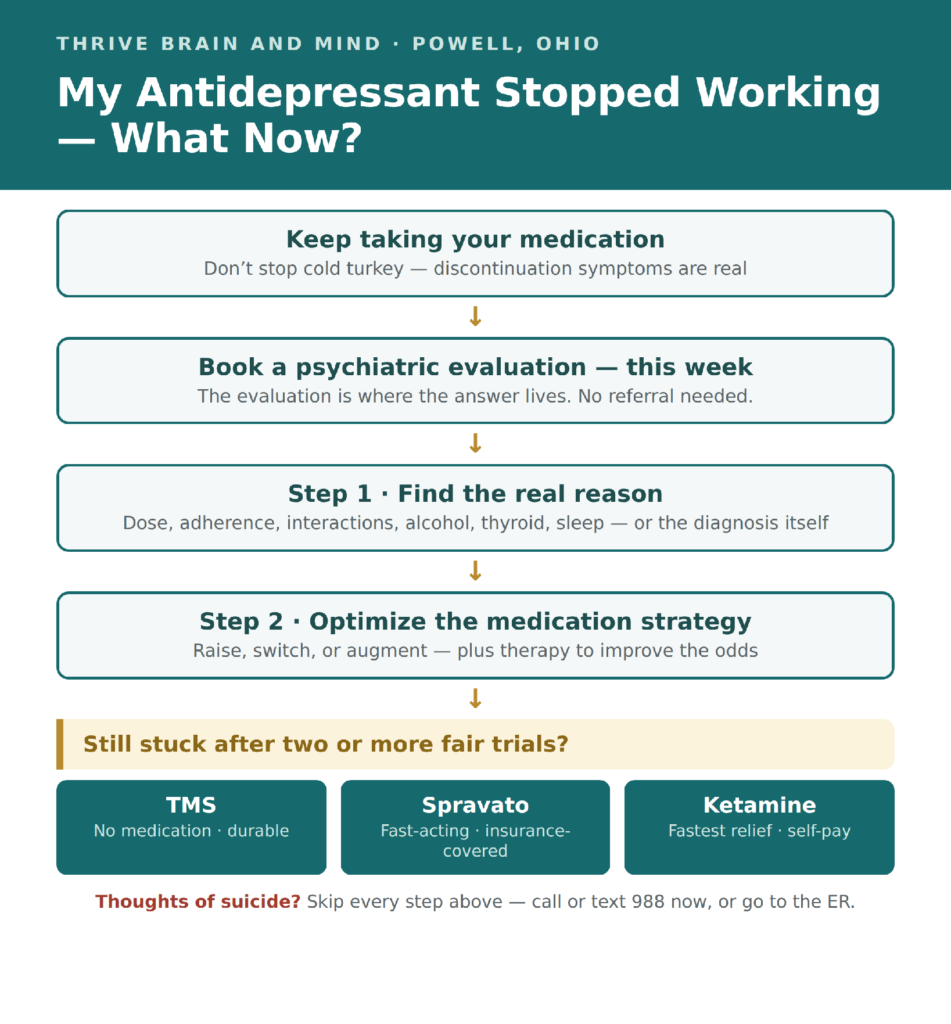
- Don’t stop your medication on your own. Quitting cold turkey can trigger discontinuation symptoms — dizziness, nausea, “brain zaps,” irritability. It can also make the depression rebound harder. Any change should be planned with your prescriber.
- Don’t white-knuckle it for months. The research is blunt here: the longer depression goes under-treated, the harder it is to treat — and the more it costs you at work and at home. [2] Depression is not a wait-and-see illness.
- Do get a thorough psychiatric evaluation — this week if you can, not “someday.” The evaluation is where the answer lives.
One exception outranks everything above. If you’re having thoughts of suicide or of harming yourself, don’t wait for an appointment. Call or text 988, the Suicide & Crisis Lifeline, right now — or go to the nearest emergency room.
The Action Plan: How We Solve This, Step by Step
When a patient like Mark sits down in my office, we don’t guess. We work a plan. After more than 30 years of practicing psychiatry, I can tell you it comes down to three steps.
Step 1: Find the real reason
First, we review the basics with fresh eyes. The dose. How long you’ve truly been at that dose. Missed doses. Every other medication and supplement you take. Alcohol and substance use. Your sleep. We run lab work to rule out medical look-alikes, like thyroid disease or vitamin deficiencies. And we re-examine the diagnosis itself. A surprising amount of “my antidepressant stopped working” turns out to be one of these — and fixing it brings the response back.
Step 2: Optimize the medication strategy
If the foundation checks out, we tune the treatment. We might raise the dose. We might switch — say, from an SSRI to a serotonin-norepinephrine reuptake inhibitor (SNRI). We might add an augmentation medication that boosts the one you’re on. Pairing medication with cognitive behavioral therapy (CBT) measurably improves the odds. These moves help many people. For some, they’re the whole answer.
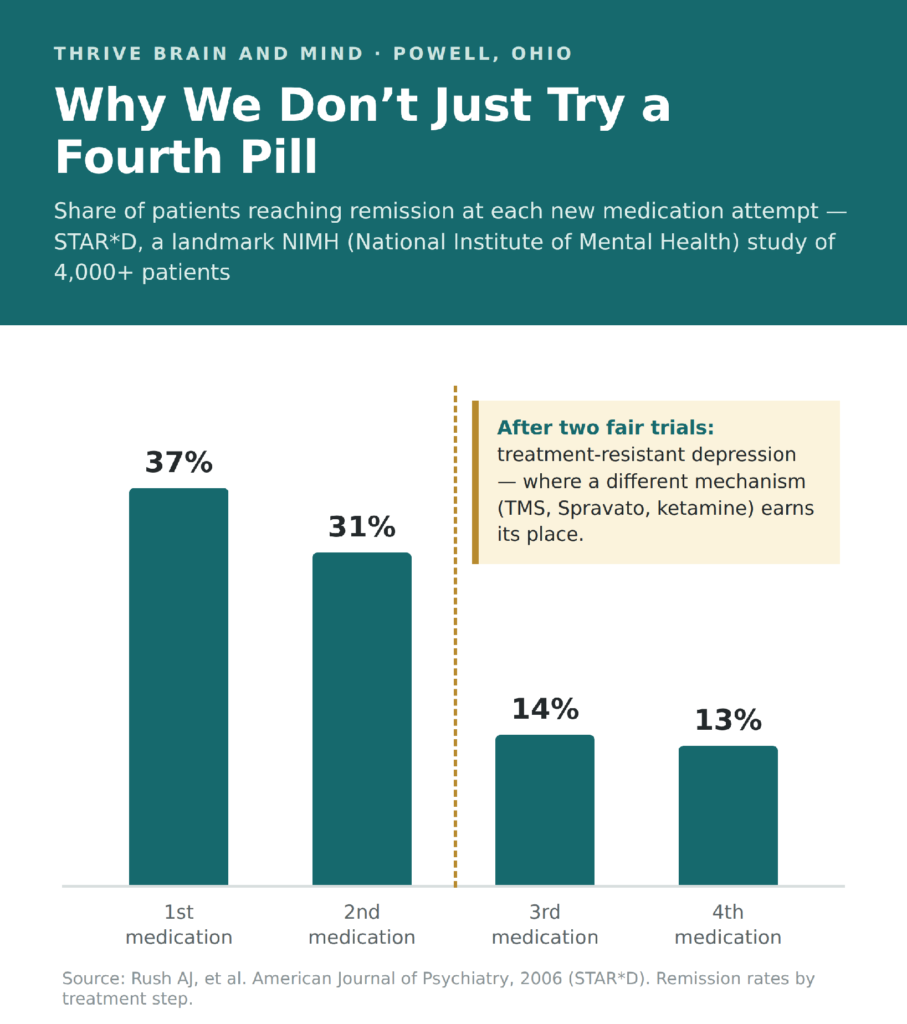
But I owe you the honest math. The largest real-world study of depression treatment ever run is the Sequenced Treatment Alternatives to Relieve Depression (STAR*D) trial. It followed more than 4,000 patients. About one in three got fully well on their first antidepressant. About one in four got well on the second try. By the third and fourth medications, the odds of remission dropped to roughly one in seven. [3] And each new trial costs you six to eight weeks while you wait to find out. That’s why, after two well-run medication trials have failed, I change the conversation.
“When two medications haven’t worked, the answer is usually not a third pill. It’s a different mechanism entirely.”
Step 3: Move beyond the pill — treatments that work differently
Failing two adequate antidepressant trials has a name: treatment-resistant depression (TRD). It’s common — roughly 30 percent of adults treated for major depression meet that definition. [4] And the name is misleading. This kind of depression is resistant to those particular medications — not to all treatment. At Thrive Brain and Mind, we offer three options that work through entirely different biology:
- Transcranial Magnetic Stimulation (TMS). Cleared by the U.S. Food and Drug Administration (FDA), TMS uses focused magnetic pulses to re-awaken the brain’s mood circuits. No medication. No sedation. You drive yourself home after each session. In a multisite study of patients whose medications had failed, 58 percent responded and 37 percent reached full remission. [5] In a year-long follow-up, about two out of three responders were still doing well at 12 months. [6] Typically covered by insurance for TRD.
- Spravato (esketamine). An FDA-approved nasal spray, taken in our office under supervision. It works on the brain’s glutamate system rather than serotonin. Some patients feel real improvement within the first one to two weeks. [7] As of the FDA’s 2025 update, Spravato can be used for treatment-resistant depression on its own or alongside an oral antidepressant. [8] Usually covered by insurance.
- Ketamine injection therapy. Used off-label for depression — meaning it isn’t FDA-approved for this use, but it’s a legal, accepted medical practice with proper informed consent. It’s the fastest-acting option we offer. In a landmark NIMH trial, many patients improved within 24 hours of a single dose. [9] Typically self-pay.
Which one fits you depends on your history, your goals, your insurance, and your medical picture. I’ve written a full side-by-side comparison of Spravato, TMS, and ketamine if you want the deep dive. But you don’t have to figure this out alone. That’s my job.
| Option | What it involves | Time to relief | Typical coverage |
|---|---|---|---|
| Adjust, switch, or augment medication | New dose or medication guided by a fresh evaluation; add CBT | 2–8 weeks per trial | Insurance |
| TMS | Magnetic stimulation; 20–40 min sessions, 5 days/week for 4–6 weeks; no downtime | Often by weeks 4–6; durable | Insurance (criteria apply) |
| Spravato (esketamine) | Supervised nasal spray in-office; ~2-hour visits, twice weekly at first | Days to weeks for some | Insurance (criteria apply) |
| Ketamine injection | Off-label injection under medical supervision and monitoring | Hours to days for some | Self-pay |
The Results: What Getting Better Looks Like From Here
Back to Mark. His evaluation found no hidden medical cause, and he’d already had two full, fair medication trials. So he chose TMS and stayed on his current medication. Week three: nothing — which I’d warned him about, because TMS starts slow. Week five: his wife noticed he was singing in the car again. Week seven: he told me the lightbulb was back on. At his one-year follow-up, he was still well. Not every story is Mark’s. Some of my patients get there with a simple dose change. Others get there with Spravato or ketamine. The point is that there was a next step — and we found it.
Zoom out, and the numbers tell the same story. In STAR*D, patients who kept stepping through evidence-based options — instead of giving up — reached remission about two-thirds of the time. [3] And that study wrapped up before TMS was widely available, and more than a decade before esketamine existed as a depression treatment. Your toolbox today is bigger than the one that produced those numbers.
Here’s what results actually look like in my office. Sleeping through the night. Having energy left for your kids at 6 p.m. Caring about your work again. Making plans — and keeping them. Getting your “want to” back. That’s the standard we treat to at Thrive Brain and Mind: remission, not just “a little better.”
Why Patients Choose Thrive Brain and Mind
Plenty of clinics can renew a prescription. What makes us different is what happens when the prescription isn’t enough:
- Every option under one roof. We provide medication management, therapy, TMS, Spravato, and ketamine injection therapy in one practice. So our only agenda is finding what actually fits you — not steering you toward the one treatment we happen to offer.
- Experience you can lean on. I’m Dr. John J. Aziz, a quadruple board-certified psychiatrist with more than 30 years of clinical experience, including extensive work in interventional psychiatry.
- Certified safety. We are a Risk Evaluation and Mitigation Strategy (REMS)-certified Spravato treatment center. That means we meet the FDA’s strict requirements for administering esketamine safely.
- Urgency without pressure. A consultation starts with a thorough evaluation — not a sales pitch — and ends with a clear, honest plan. Our team verifies your insurance benefits before treatment begins. And when you tell us your antidepressant has stopped working, we treat that as the urgent problem it is.
Depression Help in Powell and Columbus, Ohio
Thrive Brain and Mind serves the greater Columbus area — Dublin, Westerville, Lewis Center, Delaware, and Upper Arlington — from our clinic at 3785 Attucks Drive in Powell, Ohio. We also have a second office in Logan for southeastern Ohio. If your antidepressant has stopped working, don’t spend another season waiting it out.
→ Schedule a consultation at Thrive Brain and Mind — call 614-588-8177 or request an appointment online.
Frequently Asked Questions
Why did my antidepressant stop working?
There are several common reasons. The brain can adapt to the medication over time — doctors call this antidepressant tachyphylaxis. Missed doses, new medications, alcohol or substance use, thyroid problems, and mounting life stress can all play a role. Sometimes the diagnosis itself needs a second look. Studies estimate this loss of response affects roughly 9 to 33 percent of people on long-term antidepressants. A psychiatric evaluation can usually find which cause applies to you.
Should I stop taking an antidepressant that isn’t working?
No — not on your own. Stopping abruptly can cause discontinuation symptoms like dizziness, nausea, and “brain zaps.” It can also make the depression return harder. Keep taking your medication as prescribed, and contact your prescriber or a psychiatrist promptly to plan the next step safely.
What is treatment-resistant depression (TRD)?
Treatment-resistant depression (TRD) means depression that hasn’t responded well to at least two antidepressants, taken at the right dose for the right amount of time. Roughly 30 percent of adults treated for major depression meet this definition. TRD does not mean untreatable. It means your depression may respond better to treatments that work differently — like TMS, Spravato, or ketamine.
What are my options if two or more antidepressants haven’t worked?
After a full evaluation, options include augmentation strategies, therapy, and three interventional treatments offered at Thrive Brain and Mind: Transcranial Magnetic Stimulation (TMS), Spravato (esketamine) nasal spray, and ketamine injection therapy. Each works through a different mechanism than standard antidepressants. And each has helped patients who didn’t improve on multiple medications.
How quickly do treatments like Spravato or TMS work?
Some patients on Spravato notice real improvement within the first one to two weeks. Ketamine can act within hours to days. TMS builds more gradually — most patients notice significant improvement around weeks four to six — and its benefits tend to last. Your timeline depends on your history and the treatment chosen.
Where can I get help for depression that isn’t responding to medication near Columbus, Ohio?
Thrive Brain and Mind in Powell, Ohio is a REMS-certified Spravato treatment center. We offer TMS, ketamine injection therapy, and expert medication management, and we serve the greater Columbus area. Call 614-588-8177 to schedule an evaluation with Dr. John J. Aziz.
This article is for education and is not a substitute for personalized medical advice, diagnosis, or treatment. Never start or stop a prescription medication without talking to your prescriber. If you are in crisis, call or text 988 — the Suicide & Crisis Lifeline — available 24/7.
RESOURCES & STUDIES CITED
1. Targum SD. Identification and treatment of antidepressant tachyphylaxis. Innovations in Clinical Neuroscience. 2014;11(3–4):24–28. https://innovationscns.com/identification-and-treatment-of-antidepressant-tachyphylaxis/
2. Ghio L, et al. Duration of untreated illness and outcomes in unipolar depression: a systematic review and meta-analysis. Journal of Affective Disorders. 2014;152–154:45–51. https://pubmed.ncbi.nlm.nih.gov/24183486/
3. Rush AJ, et al. Acute and longer-term outcomes in depressed outpatients requiring one or several treatment steps: a STAR*D report. American Journal of Psychiatry. 2006;163(11):1905–1917. https://psychiatryonline.org/doi/10.1176/ajp.2006.163.11.1905
4. Zhdanava M, et al. The prevalence and national burden of treatment-resistant depression and major depressive disorder in the United States. Journal of Clinical Psychiatry. 2021;82(2):20m13699. https://pubmed.ncbi.nlm.nih.gov/33989464/
5. Carpenter LL, et al. Transcranial magnetic stimulation (TMS) for major depression: a multisite, naturalistic, observational study of acute treatment outcomes in clinical practice. Depression and Anxiety. 2012;29(7):587–596. https://onlinelibrary.wiley.com/doi/abs/10.1002/da.21969
6. Dunner DL, et al. A multisite, naturalistic, observational study of transcranial magnetic stimulation for patients with pharmacoresistant major depressive disorder: durability of benefit over a 1-year follow-up period. Journal of Clinical Psychiatry. 2014;75(12):1394–1401. https://www.psychiatrist.com/jcp/multisite-naturalistic-observational-study-transcranial/
7. Popova V, et al. Efficacy and safety of flexibly dosed esketamine nasal spray combined with a newly initiated oral antidepressant in treatment-resistant depression (TRANSFORM-2). American Journal of Psychiatry. 2019;176(6):428–438. https://pubmed.ncbi.nlm.nih.gov/31109201/
8. Johnson & Johnson. SPRAVATO® (esketamine) approved in the U.S. as the first and only monotherapy for adults with treatment-resistant depression. January 2025. https://www.jnj.com/media-center/press-releases/spravato-esketamine-approved-in-the-u-s-as-the-first-and-only-monotherapy-for-adults-with-treatment-resistant-depression
9. Zarate CA Jr, et al. A randomized trial of an N-methyl-D-aspartate antagonist in treatment-resistant major depression. Archives of General Psychiatry. 2006;63(8):856–864. https://pubmed.ncbi.nlm.nih.gov/16894061/